Advertisements
Advertisements
प्रश्न
When a 12 V battery is connected across an unknown resistor, there is a current of 2.5 mA in the circuit. Calculate the value of the resistance of the resistor.
Advertisements
उत्तर
VoltageV = 12 V
current flowing in the circuit I = 2.5 mA = 2.5 × 10⁻³ A
∴ Resistance (R) = `"V"/"I"`
= `12/(2.5 xx 10^-3)`
R = `(12 xx 10^3)/25`
R = 4800 Ω
R = `4800/1000` KΩ
R = 4.8 KΩ
APPEARS IN
संबंधित प्रश्न
What is an Ohmic resistor?
Ohm's law gives a relationship between:
(a) current and resistance
(b) resistance and potential difference
(c) potential difference and electric charge
(d) current and potential difference
The resistors R1, R2, R3 and R4 in the figure given below are all equal in value.
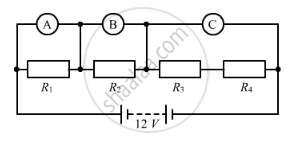
What would you expect the voltmeter A, B and C to read assuming that the connecting wires in the circuit have negligible resistance?
How much energy is consumed when a current of 5 amperes flows through the filament (or element) of a heater having resistance of 100 ohms for two hours? Express it in joules.
A resistance of 40 ohms and one of 60 ohms are arranged in series across 220 volt supply. Find the heat in joules produced by this combination of resistances in half a minute.
- Draw a V-I graph for a conductor obeying Ohm’s law.
- What does the slope of V–I graph for a conductor represent?
A wire of resistance 9 ohm having length 30 cm is tripled on itself. What is its new resistance?
Show by a diagram how two resistors R1 and R2 are joined in parallel. Obtain an expression for the total resistance of the combination.
Calculate the electric field in a copper wire of cross-sectional area 2.0 mm2 carrying a current of 1 A.
The resistivity of copper = 1.7 × 10⁻⁸ Ω m
The filament of a bulb takes a current 100 mA when potential difference across it is 0.2 V. When the potential difference across it becomes 1.0 V, the current becomes 400 mA. Calculate the resistance of filament in each case and account for the difference.
State the relation correlating the electric current flowing in a conductor and the voltage applied across it. Also, draw a graph to show this relationship.
Ohm’s law states the relationship between power and voltage.
Assertion: The statement of Ohm’s law is K = IR.
Reason: V = IR is the equation which defines resistance.
A student carries out an experiment and plots the V-I graph of three samples of nichrome wire with resistances R1, R2 and R3 respectively. Which of the following is true?

The heat produced by a 100 w heater in 2 minute is equal to
You are provided with a resistor, a key, an ammeter, a voltmeter, four cells of 1.5 V each and few connecting wires. Using circuit components, draw a labelled circuit diagram to show the setup to study Ohm's law.
State the relationship between potential difference (V) across the resistor and the current (I) flowing through it. Also draw V-I graph, taking V on the X-axis.
In the context of Ohm's Law, Current (I) is defined as:
The mathematical form of Ohm's Law is:
What is the nature of the graph obtained when potential difference is plotted against current for an Ohmic conductor?
