Advertisements
Advertisements
Question
When a 12 V battery is connected across an unknown resistor, there is a current of 2.5 mA in the circuit. Calculate the value of the resistance of the resistor.
Advertisements
Solution
VoltageV = 12 V
current flowing in the circuit I = 2.5 mA = 2.5 × 10⁻³ A
∴ Resistance (R) = `"V"/"I"`
= `12/(2.5 xx 10^-3)`
R = `(12 xx 10^3)/25`
R = 4800 Ω
R = `4800/1000` KΩ
R = 4.8 KΩ
APPEARS IN
RELATED QUESTIONS
Find the resistance of a conductor if 0.24 A current is passing through it and a potential difference of 24 V is applied across it.
Write the formula of resistivity
Ohm's law gives a relationship between:
(a) current and resistance
(b) resistance and potential difference
(c) potential difference and electric charge
(d) current and potential difference
The unit of electrical resistance is:
(a) ampere
(b) volt
(c) coulomb
(d) ohm
Fill in the following blank with suitable words:
Resistance is measured in .............. The resistance of a wire increases as the length ..............; as the temperature ..............; and as the cross-sectional area .............. .
Calculate the effective resistance across AB?
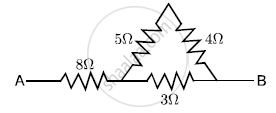
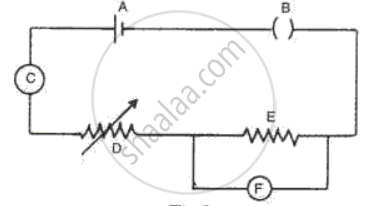
Fig. represents the circuit used for the verification of Ohm's law. Label the parts from A to F. state the function of each.
Answer the following question.
Distinguish between Ohmic and non-ohmic substances; explain with the help of example.
Ohm’s law states the relationship between power and voltage.
Which of the following is correct for V-I graph of a good conductor?
The heat produced by a 100 w heater in 2 minute is equal to
A metal rod of length 10 cm and a rectangular cross-section of 1 cm × `1/2` cm is connected to a battery across opposite faces. The resistance will be ______.
Two cells of same emf E but internal resistance r1 and r2 are connected in series to an external resistor R (Figure). What should be the value of R so that the potential difference across the terminals of the first cell becomes zero.
Why should an ammeter have low resistance?
Ohm's Law states that for a metallic conductor, the current flowing through it is directly proportional to the potential difference across its ends, provided that:
The mathematical form of Ohm's Law is:
In which unit is the resistance of a conductor measured?
From Ohm's Law, since \[I \propto V\], the constant ratio \[\frac{V}{I}\] is defined as:
