Advertisements
Advertisements
Question
Define the unit of resistance (or Define the unit "ohm").
Advertisements
Solution
One ohm (Ω) is the resistance of a conductor when a potential difference of one volt is applied to its ends and a current of one ampere flows through it.
APPEARS IN
RELATED QUESTIONS
What is meant by saying that the electric potential at a point is 1 volt?
Define one coulomb charge.
What is a voltmeter?
The differences between the electrostatic potential of the positive and the negative end of an electric cell is the ______ of the cell.
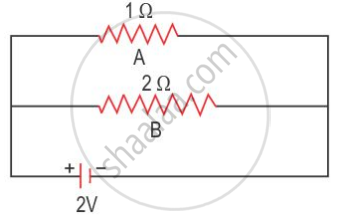
Calculate the current flowing through each of the resistors A and B in the circuit shown in the following figure.
Draw a graph of Potential difference (V) versus Current (I) for an ohmic resistor. How can you find the resistance of the resistor from this graph?
A 10 m long wire of a particular material is of resistance 5Ω What will be the resistance of 10m long wire of the same material but the double radius.
Potential near a charge is the measure of its ______ to bring a positive charge at that point.
A battery of 10 volt carries 20,000 C of charge through a resistance of 20 Ω. The work done in 10 seconds is:
A boy records that 4000 joules of work are required to transfer 10 coulombs of charge between two points of a resistor of 50 Ω. The current passing through it is:
