Advertisements
Advertisements
Question
State Ohm’s law.
Advertisements
Solution
Ohm’s law states that electric potential difference across two points in an electrical circuit is directly proportional to the current passing through it. That is,
V~I
The proportionality constant is tne resistance (R) offered between the two points.
Hence, Ohm’s law is written as,
V = RI (or) V = IR
Where, V is the potential difference in volt (V), I is the current flow in ampere (A), R is the resistance in ohm (Ω)
RELATED QUESTIONS
The values of current I flowing in a given resistor for the corresponding values of potential difference V across the resistor are given below:
| I (amperes) | 0.5 | 1.0 | 2.0 | 3.0 | 4.0 |
| V (volts) | 1.6 | 3.4 | 6.7 | 10.2 | 13.2 |
Plot a graph between V and I and calculate the resistance of that resistor.
How much work is done in moving a charge of 2 C across two points having a potential difference of 12 V?
State the relation between potential difference, work done and charge moved.
What is the potential difference between the terminals of a battery if 250 joules of work is required to transfer 20 coulombs of charge from one terminal of battery to the other?
Name the law which relates the current in a conductor to the potential difference across its ends.
What is the ratio of potential difference and current known as?
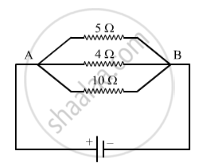
In the circuit diagram given below, the current flowing across 5 ohm resistor is 1 amp. Find the current flowing through the other two resistors.
What current will be taken by a 920 W appliance if the supply voltage is 230 V?
Explain the analogy between the flow of charge (or current) in a conductor under a potential difference with the free fall of a body under gravity.
Define the term ‘volt’.
Write proper word from the following group of words in the blank.
(magnetism, 4.5V, 3.0V, gravitational attraction, potential difference, potential, higher, lower, 0V)
Water in the waterfall flows from a higher level to the lower level because of ______.
What would you suggest to a student if while performing an experiment he finds that the pointer/needle of the ammeter and voltmeter do not coincide with the zero marks on the scales when the circuit is open? No extra ammeter/voltmeter is available in the laboratory.
Five resistors of different resistances are connected together as shown in the figure. A 12 V battery is connected to the arrangement.
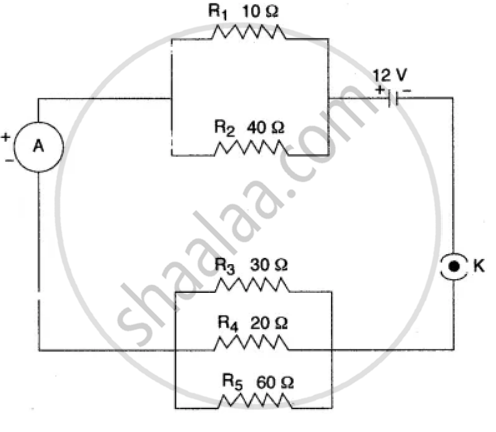
Calculate:
(i) the total resistance in the circuit
(ii) the total current flowing in the circuit.
A 10 m long wire of a particular material is of reistance 5Ω What will be the resistance of 5m long wire of same material and the same thickness.
Conceptual question.
Does a solar cell always maintain the potential across its terminals constant? Discuss
A battery of 10 volt carries 20,000 C of charge through a resistance of 20 Ω. The work done in 10 seconds is:
100 J of heat is produced each second in a 4 Ω resistor. The potential difference across the resistor will be:
A cylindrical conductor of length l and uniform area of cross section A has resistance R. Another conductor of length 2l and resistance R of the same material has area of cross section.
The SI unit of potential difference is ______.
