Advertisements
Advertisements
प्रश्न
State Ohm’s law.
Advertisements
उत्तर
Ohm’s law states that electric potential difference across two points in an electrical circuit is directly proportional to the current passing through it. That is,
V~I
The proportionality constant is tne resistance (R) offered between the two points.
Hence, Ohm’s law is written as,
V = RI (or) V = IR
Where, V is the potential difference in volt (V), I is the current flow in ampere (A), R is the resistance in ohm (Ω)
संबंधित प्रश्न
A battery of emf 12 V and internal resistance 2 Ω is connected with two resistors A and B of resistance 4 Ω and 6 Ω respectively joined in series.
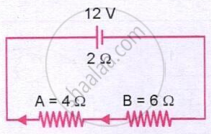
Find:
- Current in the circuit.
- The terminal voltage of the cell.
- The potential difference across 6Ω Resistor.
- Electrical energy spent per minute in the 4Ω resistor.
What is the unit of electric charge?
Name a device that help to measure the potential difference across a conductor.
Name the law which relates the current in a conductor to the potential difference across its ends.
What p.d. is needed to send a current of 6 A through an electrical appliance having a resistance of 40 Ω?
What current will be taken by a 920 W appliance if the supply voltage is 230 V?
State the S.I. unit of electric potential.
Calculate the potential difference between the two terminals of a battery if 100 joules of work is required to transfer 20 coulombs of charge from one terminal of the battery to the other.
What would you suggest to a student if while performing an experiment he finds that the pointer/needle of the ammeter and voltmeter do not coincide with the zero marks on the scales when the circuit is open? No extra ammeter/voltmeter is available in the laboratory.
Find the resistance of a conductor if the electric current flowing through it is 0.35 A when the potential difference across it is 1.4 V.
Five resistors of different resistances are connected together as shown in the figure. A 12 V battery is connected to the arrangement.
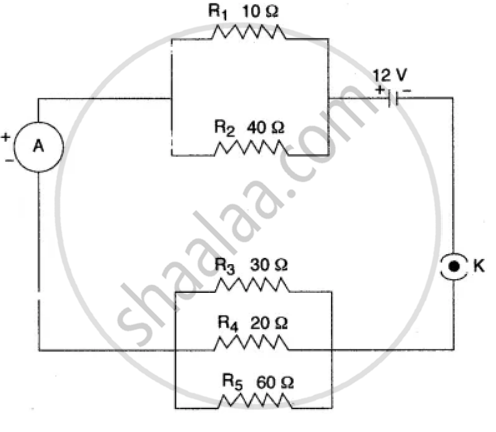
Calculate:
(i) the total resistance in the circuit
(ii) the total current flowing in the circuit.
In the figure given below, A, B and C are three ammeters. The ammeter B reads 0.5A. (All the ammeters have negligible resistance.)
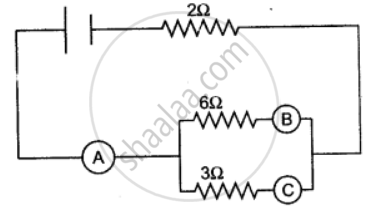
Calculate:
(i) the readings in the ammeters A and C.
(ii) the total resistance of the circuit.
Two bulbs are marked 100 W, 220 V and 60 W, 110 V. Calculate the ratio of their resistances.
If P and V are the power and potential of device, the power consumed with a supply potential V1 is:
Find out the following in the electric circuit given in Figure
- Effective resistance of two 8 Ω resistors in the combination
- Current flowing through 4 Ω resistor
- Potential difference across 4 Ω resistance
- Power dissipated in 4 Ω resistor
- Difference in ammeter readings, if any.

The SI unit of potential difference is ______.
Name the instrument which is used to measure the potential difference.
______ is work done per unit charge.
