Advertisements
Advertisements
प्रश्न
State Ohm’s law.
Advertisements
उत्तर
Ohm’s law states that electric potential difference across two points in an electrical circuit is directly proportional to the current passing through it. That is,
V~I
The proportionality constant is tne resistance (R) offered between the two points.
Hence, Ohm’s law is written as,
V = RI (or) V = IR
Where, V is the potential difference in volt (V), I is the current flow in ampere (A), R is the resistance in ohm (Ω)
संबंधित प्रश्न
Name a device that helps to maintain a potential difference across a conductor.
What do you understand by the term "electric potential"? (or potential) at a point? What is the unit of electric potential?
What is the potential difference between the terminals of a battery if 250 joules of work is required to transfer 20 coulombs of charge from one terminal of battery to the other?
Name a device which helps to maintain potential difference across a conductor (say, a bulb).
The p.d. across a lamp is 12 V. How many joules of electrical energy are changed into heat and light when:
a charge of 5 C passes through it?
Name the law which relates the current in a conductor to the potential difference across its ends.
Keeping the potential difference constant, the resistance of a circuit is doubled. By how much does the current change?
Write down the formula which states the relation between potential difference, current, and resistance.
Define the term ‘volt’.
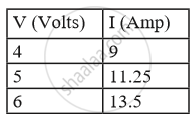
The following table shows current in Amperes and potential difference in Volts.
What will be the nature of the graph between the current and potential difference? (Do not draw a graph.)
Three electric cells of potential difference 1.5 V each have been connected as a battery. The potential differences of the battery will be ____________ V.
The voltage across a 3Ω resistance is 6 V. How large is the current? What is
the resistance of a filament lamp when a voltage of 3 V across it causes a
current of 0.5 A?
Point out two differences between e.m.f. and potential difference as applied to electric circuits.
Three resistors are connected to a 6 V battery as shown in the figure given below:
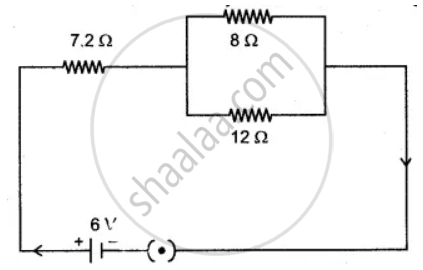
Calculate:
(i) the equivalent resistance of the circuit.
(ii) total current in the circuit.
(iii) potential difference across the 7.2 Ω resistor.
In the figure given below, A, B and C are three ammeters. The ammeter B reads 0.5A. (All the ammeters have negligible resistance.)
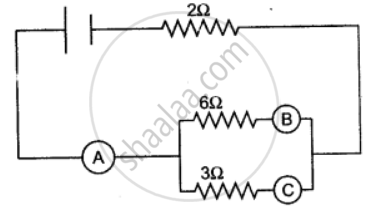
Calculate:
(i) the readings in the ammeters A and C.
(ii) the total resistance of the circuit.
A battery of 10 volt carries 20,000 C of charge through a resistance of 20 Ω. The work done in 10 seconds is:
A cylindrical conductor of length l and uniform area of cross section A has resistance R. Another conductor of length 2l and resistance R of the same material has area of cross section.
An electric charge always flows from a point at a ______ to a point at a ______.
Twenty-seven drops of same size are charged at 220 V each. They combine to form a bigger drop. Calculate the potential of the bigger drop.
