Advertisements
Advertisements
प्रश्न
Define Electric potential.
Advertisements
उत्तर
Electric potential is a measure of work done on the unit's positive charge to bring it to that point against all electrical forces. It is represented as ‘V’.
APPEARS IN
संबंधित प्रश्न
Which of the following statements correctly defines a volt?
(a) a volt is a joule per ampere.
(b) a volt is a joule per coulomb.
How much work is done when one coulomb charge moves against a potential difference of 1 volt?
What is the SI unit of potential difference?
What do you understand by the term "electric potential"? (or potential) at a point? What is the unit of electric potential?
Explain the analogy between the flow of charge (or current) in a conductor under a potential difference with the free fall of a body under gravity.
State whether the potential is a scalar or vector?
Five resistors of different resistances are connected together as shown in the figure. A 12 V battery is connected to the arrangement.
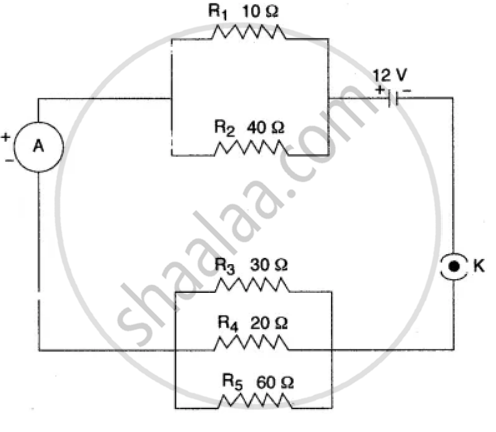
Calculate:
(i) the total resistance in the circuit
(ii) the total current flowing in the circuit.
The figure shows a circuit. When the circuit is switched on, the ammeter reads 0.5 A.
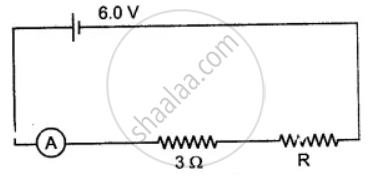
(i) Calculate the value of the unknown resistor R.
(ii) Calculate the charge passing through the 3 Ω resistor in 120 s.
(iii) Calculate the power dissipated in the 3 Ω resistor.
A current of 0.2 A flows through a conducting wire for 5 minutes. How much charge will flow?
Inside a hollow charged spherical conductor, the potential ______
