Advertisements
Advertisements
प्रश्न
The figure shows a circuit. When the circuit is switched on, the ammeter reads 0.5 A.
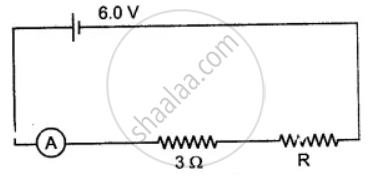
(i) Calculate the value of the unknown resistor R.
(ii) Calculate the charge passing through the 3 Ω resistor in 120 s.
(iii) Calculate the power dissipated in the 3 Ω resistor.
Advertisements
उत्तर
(i) We know, V = IR'
⇒ 6 = 0.5 × R'
⇒ R' = 12 Ohm
∵ R' = 3 + R
⇒ 12 = 3 + R
⇒ R = 9 Ohm
(ii) Charge, q = i t
⇒ q = 0.5 × 120 = 60 Coulomb
(iii) Power dissipation, p = i2R
p = 0.52 × 3 = 0.75 Watt
संबंधित प्रश्न
How much energy is given to each coulomb of charge passing through a 6 V battery?
Name a device that help to measure the potential difference across a conductor.
The p.d. across a lamp is 12 V. How many joules of electrical energy are changed into heat and light when: a current of 2 A flows through it for 10 s?
A potential difference of 20 volts is applied across the ends of a resistance of 5 ohms. What current will flow in the resistance?
The potential difference between the terminals of an electric iron is 240 V and the current is 5.0 A. What is the resistance of the electric iron?
State the S.I. unit of electric potential.
Calculate the potential difference between the two terminals of a battery if 100 joules of work is required to transfer 20 coulombs of charge from one terminal of the battery to the other.
A cell of e.m.f 2.0 V and internal resistance 1Ω is connected to the resistors of 3Ω and 6Ω in series. Calculate:
(i) the current drawn from the cell,
(ii) the p.d. across each resistor,
(iii) the terminal voltage of the cell and
(iv) the voltage drop.
A current of 100 mA. flows through a wire. The charge on an electron is 1.6 × 10⁻¹⁹ C. Find the number of electrons passing per second through the cross-section of the conductor.
Which of the following represents voltage?
