Advertisements
Advertisements
प्रश्न
In the figure given below, A, B and C are three ammeters. The ammeter B reads 0.5A. (All the ammeters have negligible resistance.)
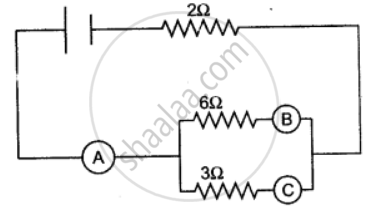
Calculate:
(i) the readings in the ammeters A and C.
(ii) the total resistance of the circuit.
Advertisements
उत्तर
(i) P.d. across 6 Ω = P. d. across 3 Ω
Or 6 × 0.5 = 3 × ic
Or ic i.e., current passing through the ammeter C is:
`(6 xx 0.5)/3 = 1.0`ampere
(ii) Here, `1/"R" = 1/6 + 1/3 = 3/6 = 1/2`
or R = 2 Ω
∴ Total ressistance of the circuit = 2Ω + R = 2Ω + 2Ω = 4Ω
∴ Current through A = Current passing through B + current passing through C
= 0.5 + 1.0 = 1.5 ampere
संबंधित प्रश्न
Calculate the work done in moving a charge of 4 coulombs from a point at 220 volts to another point at 230 volts.
A p.d. of 10 V is needed to make a current of 0.02 A flow through a wire. Wire p.d. is needed to make a current of 250 mA flow through the same wire?
A current of 200 mA flows through a 4 kΩ resistor. What is the p.d. across the resistor?
In the circuit shown below:
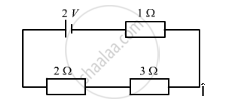
The potential difference across the 3 Ω resistor is:
Explain the statement ‘the potential difference between two points is 1 volt’.
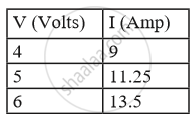
The following table shows current in Amperes and potential difference in Volts.
What will be the nature of the graph between the current and potential difference? (Do not draw a graph.)
Write proper word from the following group of words in the blank.
(magnetism, 4.5V, 3.0V, gravitational attraction, potential difference, potential, higher, lower, 0V)
Water in the waterfall flows from a higher level to the lower level because of ______.
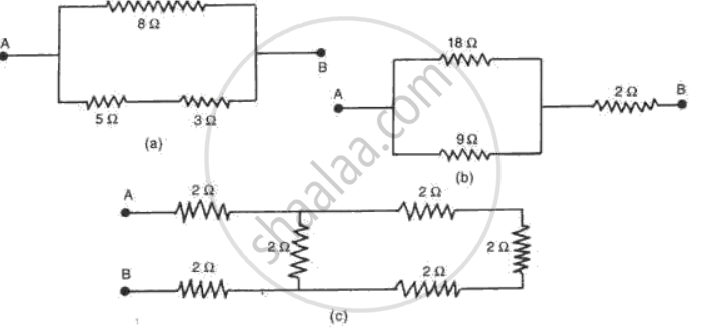
What is the combined resistance of each of the networks between A and B shown in fig. ?
Five resistors of different resistances are connected together as shown in the figure. A 12 V battery is connected to the arrangement.
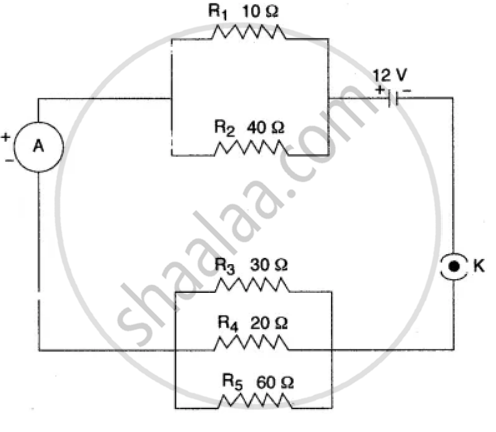
Calculate:
(i) the total resistance in the circuit
(ii) the total current flowing in the circuit.
Potential near a charge is the measure of its ______ to bring a positive charge at that point.
