Advertisements
Advertisements
प्रश्न
In the figure given below, A, B and C are three ammeters. The ammeter B reads 0.5A. (All the ammeters have negligible resistance.)
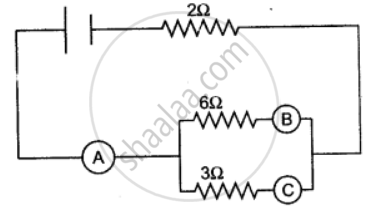
Calculate:
(i) the readings in the ammeters A and C.
(ii) the total resistance of the circuit.
Advertisements
उत्तर
(i) P.d. across 6 Ω = P. d. across 3 Ω
Or 6 × 0.5 = 3 × ic
Or ic i.e., current passing through the ammeter C is:
`(6 xx 0.5)/3 = 1.0`ampere
(ii) Here, `1/"R" = 1/6 + 1/3 = 3/6 = 1/2`
or R = 2 Ω
∴ Total ressistance of the circuit = 2Ω + R = 2Ω + 2Ω = 4Ω
∴ Current through A = Current passing through B + current passing through C
= 0.5 + 1.0 = 1.5 ampere
APPEARS IN
संबंधित प्रश्न
How much work is done when one coulomb charge moves against a potential difference of 1 volt?
What do you understand by the term "potential difference"?
What is the ratio of potential difference and current known as?
Explain the statement ‘the potential difference between two points is 1 volt’.
The voltage across a 3Ω resistance is 6 V. How large is the current? What is
the resistance of a filament lamp when a voltage of 3 V across it causes a
current of 0.5 A?
What would you suggest to a student if while performing an experiment he finds that the pointer/needle of the ammeter and voltmeter do not coincide with the zero marks on the scales when the circuit is open? No extra ammeter/voltmeter is available in the laboratory.
Suppose there are three resistors A, B, and C having resistances r1, r2, and r3 respectively. If R represents their equivalent resistance, establish the following relation R = r1 + r2 + r3 when joined in series.
Two bulbs are marked 100 W, 220 V and 60 W, 110 V. Calculate the ratio of their resistances.
A 10 m long wire of a particular material is of resistance 5Ω What will be the resistance if the wire is stretched to double its length?
A cylindrical conductor of length l and uniform area of cross section A has resistance R. Another conductor of length 2l and resistance R of the same material has area of cross section.
