Advertisements
Advertisements
प्रश्न
Define the following:
Potential difference
Advertisements
उत्तर
Potential difference: The potential difference between two points may be defined as the work done in moving a unit positive charge from one point to the other.
APPEARS IN
संबंधित प्रश्न
State two causes of energy loss in a transformer.
What do the letters p.d. stand for?
What is the SI unit of potential difference?
What is the unit of electric charge?
Potential difference is measured in _________ by using a ___________ placed in ___________ across a component.
What is Ohm's law? Explain how it is used to define the unit of resistance.
The device used for measuring potential difference is
What do you understand by the resistance of a wire?
Three resistors are connected to a 12 V battery as shown in the figure given below:
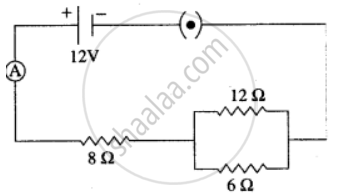
(i) What is the current through the 8 ohm resistor?
(ii) What is the potential difference across the parallel combination of 6 ohm and 12 ohm resistor?
(iii) What is the current through the 6 ohm resistor?
What is the measure of the work done on the unit positive charge to bring it to that point against all electrical forces?
