Advertisements
Advertisements
Question
Define the following:
Potential difference
Advertisements
Solution
Potential difference: The potential difference between two points may be defined as the work done in moving a unit positive charge from one point to the other.
APPEARS IN
RELATED QUESTIONS
The other name of potential difference is:
Why do electricians wear rubber hand gloves while working with electricity?
What p.d. is needed to send a current of 6 A through an electrical appliance having a resistance of 40 Ω?
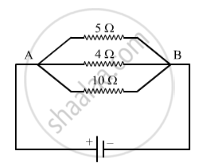
In the circuit diagram given below, the current flowing across 5 ohm resistor is 1 amp. Find the current flowing through the other two resistors.
The differences between the electrostatic potential of the positive and the negative end of an electric cell is the ______ of the cell.
Explain why potential difference is always less than the e.m.f. of a cell?
A negative charge will move from ______ to ______ potential.
What is the measure of the work done on the unit positive charge to bring it to that point against all electrical forces?
Two charged spherical conductors of radius R1 and R2 are connected by a wire. Then the ratio of surface charge densities of the spheres `(σ_1//σ_2 )` is ______.
Find the potential difference required to flow a current of 300 mA in a wire of resistance 20 Ω.
