Advertisements
Advertisements
Question
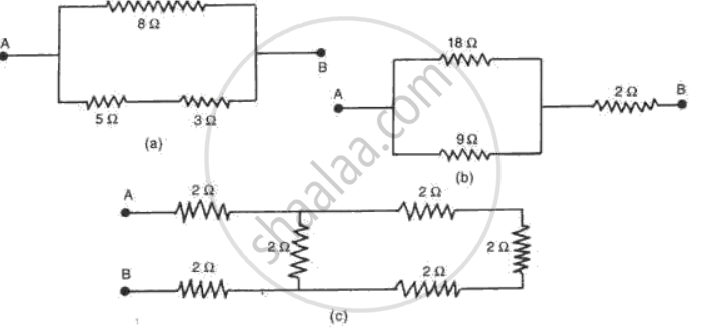
What is the combined resistance of each of the networks between A and B shown in fig. ?
Advertisements
Solution
(a) Between A andB,resistances 5Ω and 3 Ω are connected in series
·. Rs =5+3=8Ω
This series combination of resistances 5Ω and 3Ω is connected in parallel with the resistance 80
:. total resistance between A and Bis given as:
R = `[1/8 + 1/8]^-1` = 4Ω
(b) Bet ween A and B ,paralle combination of resistances 9Ω and 18Ω is connected in series with resistance 2Ω.
Parallel resistance of 9Ω and 18Ω is :
Rp = `[1/9 + 1/18]^-1` = 6Ω
:. total resistance between A and B is:
R=6+2=8Ω
(c) The situation consists of three two ohm resistors connected in series between CEFD and their combination in parallel with the fourth 2 ohm resistor between C and D.
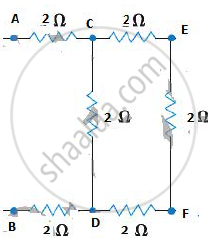
Therefore, series combination gives, 2 + 2 + 2 = 6 Ω.
This 6Ω resistor is connected in para lie I to the fourth 2Ω n resistor, therefore equivalent resistance between C and D,
`1/"R" = 1/6 + 1/2 = 2/3 Ω`
.·.R=l.5Ω
Now, between A and B the resistance Rand two 2Ω resistors are connected in series.
Therefore, equivalent resistance between A and B is
Rtotal = 2+2 +1.5 =5.5 Ω
APPEARS IN
RELATED QUESTIONS
How much energy is given to each coulomb of charge passing through a 6 V battery?
What p.d. is needed to send a current of 6 A through an electrical appliance having a resistance of 40 Ω?
A p.d. of 10 V is needed to make a current of 0.02 A flow through a wire. Wire p.d. is needed to make a current of 250 mA flow through the same wire?
A current of 1.6 mA flows through a conductor. If charge on an electron is –1.6 × 10⁻¹⁹ coulomb, find the number of electrons that will pass each second through the cross section of that conductor.
Electric cells having 2V potential difference each have been connected in the form of a battery. What will be the total potential difference of the battery in both cases?


Three resistors are connected to a 6 V battery as shown in the figure given below:
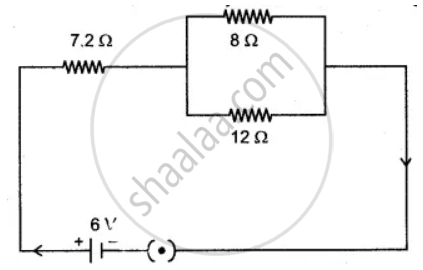
Calculate:
(i) the equivalent resistance of the circuit.
(ii) total current in the circuit.
(iii) potential difference across the 7.2 Ω resistor.
Potential near a charge is the measure of its ______ to bring a positive charge at that point.
Define Electric potential.
Twenty-seven drops of the same size are charged at 220 V each. They combine to form a bigger drop. Calculate the potential of the bigger drop.
What does the positive and negative sign of potential convey?
