Advertisements
Advertisements
Question
What does the positive and negative sign of potential convey?
Advertisements
Solution
The positive sign of potential conveys that work has to be done on the positive test charge against the repulsive force due to the positive charge in bringing it from infinity. The negative sign of potential conveys that work is done on the negative test charge by the attractive force.
APPEARS IN
RELATED QUESTIONS
Name a device that helps to maintain a potential difference across a conductor.
What is meant by saying that the electric potential at a point is 1 volt?
What is the SI unit of potential difference?
Write down the formula which states the relation between potential difference, current, and resistance.
A current of 200 mA flows through a 4 kΩ resistor. What is the p.d. across the resistor?
Three resistors are connected to a 6 V battery as shown in the figure given below:
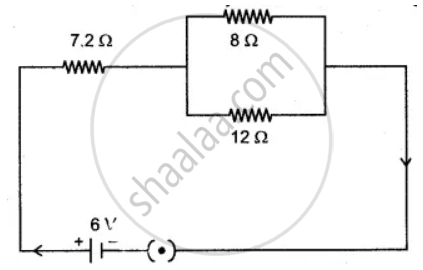
Calculate:
(i) the equivalent resistance of the circuit.
(ii) total current in the circuit.
(iii) potential difference across the 7.2 Ω resistor.
A cell of e.m.f 2.0 V and internal resistance 1Ω is connected to the resistors of 3Ω and 6Ω in series. Calculate:
(i) the current drawn from the cell,
(ii) the p.d. across each resistor,
(iii) the terminal voltage of the cell and
(iv) the voltage drop.
The SI unit of potential difference is ______.
Name a device that helps to maintain a potential difference across conductors.
Twenty-seven drops of the same size are charged at 220 V each. They combine to form a bigger drop. Calculate the potential of the bigger drop.
