Advertisements
Advertisements
Question
A cell of e.m.f 2.0 V and internal resistance 1Ω is connected to the resistors of 3Ω and 6Ω in series. Calculate:
(i) the current drawn from the cell,
(ii) the p.d. across each resistor,
(iii) the terminal voltage of the cell and
(iv) the voltage drop.
Advertisements
Solution
Total resistance of the circuit R = 1 + 3 + 6 = 10 Ω
(i) The current drawn from the cell = `"E"/"R" = 2.0/10 = 0.2` A
(ii) The p.d. across 3 Ω resistor V1 = IR1 = 0.2 × 3 = 0.6V
The p.d. across 6 Ω resistor V2 = IR2 = 0.2 × 6 = 1.2 V
(iii) The terminal voltage of the cell V = V1 + V2
= 0.6 + 1.2 = 1.8 V
(iv) The voltage drop = E - V = 2.0 - 1.8 = 0.2 V
RELATED QUESTIONS
Name a device which helps to maintain potential difference across a conductor (say, a bulb).
Keeping the resistance constant, the potential difference applied across the ends of a component is halved. By how much does the current change?
A resistance of 20 ohms has a current of 2 amperes flowing in it. What potential difference is there between its ends?
b. The values of potential difference V applied across a resistor and the correponding values of current I flowing in the resistor are given below:
| Potential difference, V (in volts) | : | 2.5 | 5.0 | 10.0 | 15.0 | 20.0 | 25.0 |
| Current, I (in amperes) | : | 0.1 | 0.2 | 0.4 | 0.6 | 0.8 | 1.0 |
Plot a graph between V and I, and calculate the resistance of the resistor.
c. Name the law which is illustrated by the above V-I graph.
Write down the formula which states the relation between potential difference, current, and resistance.
The potential difference between the terminals of an electric iron is 240 V and the current is 5.0 A. What is the resistance of the electric iron?
What is the combined resistance of each of the networks between A and B shown in fig. ?
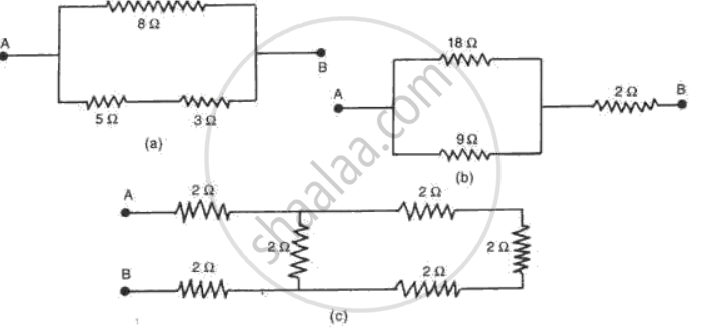
A 10 m long wire of a particular material is of resistance 5Ω What will be the resistance if the wire is doubled itself.
A 10 m long wire of a particular material is of resistance 5Ω What will be the resistance if the wire is stretched to double its length?
A negative charge will move from ______ to ______ potential.
