Advertisements
Advertisements
प्रश्न
A cell of e.m.f 2.0 V and internal resistance 1Ω is connected to the resistors of 3Ω and 6Ω in series. Calculate:
(i) the current drawn from the cell,
(ii) the p.d. across each resistor,
(iii) the terminal voltage of the cell and
(iv) the voltage drop.
Advertisements
उत्तर
Total resistance of the circuit R = 1 + 3 + 6 = 10 Ω
(i) The current drawn from the cell = `"E"/"R" = 2.0/10 = 0.2` A
(ii) The p.d. across 3 Ω resistor V1 = IR1 = 0.2 × 3 = 0.6V
The p.d. across 6 Ω resistor V2 = IR2 = 0.2 × 6 = 1.2 V
(iii) The terminal voltage of the cell V = V1 + V2
= 0.6 + 1.2 = 1.8 V
(iv) The voltage drop = E - V = 2.0 - 1.8 = 0.2 V
संबंधित प्रश्न
Which of the following statements correctly defines a volt?
(a) a volt is a joule per ampere.
(b) a volt is a joule per coulomb.
How much work is done when one coulomb charge moves against a potential difference of 1 volt?
What p.d. is needed to send a current of 6 A through an electrical appliance having a resistance of 40 Ω?
A p.d. of 10 V is needed to make a current of 0.02 A flow through a wire. Wire p.d. is needed to make a current of 250 mA flow through the same wire?
If the potential difference between the ends of a fixed resistor is halved, the electric power will become:
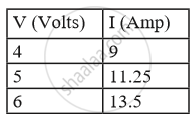
The following table shows current in Amperes and potential difference in Volts.
What will be the nature of the graph between the current and potential difference? (Do not draw a graph.)
What would you suggest to a student if while performing an experiment he finds that the pointer/needle of the ammeter and voltmeter do not coincide with the zero marks on the scales when the circuit is open? No extra ammeter/voltmeter is available in the laboratory.
Which of the following represents voltage?
An electric charge always flows from a point at a ______ to a point at a ______.
Two charged spherical conductors of radius R1 and R2 are connected by a wire. Then the ratio of surface charge densities of the spheres `(σ_1//σ_2 )` is ______.
