Advertisements
Advertisements
प्रश्न
A cell of e.m.f 2.0 V and internal resistance 1Ω is connected to the resistors of 3Ω and 6Ω in series. Calculate:
(i) the current drawn from the cell,
(ii) the p.d. across each resistor,
(iii) the terminal voltage of the cell and
(iv) the voltage drop.
Advertisements
उत्तर
Total resistance of the circuit R = 1 + 3 + 6 = 10 Ω
(i) The current drawn from the cell = `"E"/"R" = 2.0/10 = 0.2` A
(ii) The p.d. across 3 Ω resistor V1 = IR1 = 0.2 × 3 = 0.6V
The p.d. across 6 Ω resistor V2 = IR2 = 0.2 × 6 = 1.2 V
(iii) The terminal voltage of the cell V = V1 + V2
= 0.6 + 1.2 = 1.8 V
(iv) The voltage drop = E - V = 2.0 - 1.8 = 0.2 V
संबंधित प्रश्न
Calculate the quantity of heat produced in a 20 Ω resistor carrying 2.5 A current in 5 minutes.
The values of current (I) flowing through a given resistor of resistance (R), for the corresponding values of potential difference (V) across the resistor are as given below:
| V (volts) | 0.5 | 1.0 | 1.5 | 2.0 | 2.5 | 3.0 | 4.0 | 5.0 |
| I (amperes) | 0.1 | 0.2 | 0.3 | 0.4 | 0.5 | 0.6 | 0.8 | 1.0 |
Plot a graph between current (I) and potential difference (V) and determine the resistance (R) of the resistor.
By what other name is the unit joule/coulomb called?
Name a device which helps to maintain potential difference across a conductor (say, a bulb).
Ohm's law state a relation between potential difference and ___________.
What is the ratio of potential difference and current known as?
Explain the statement ‘the potential difference between two points is 1 volt’.
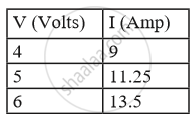
The following table shows current in Amperes and potential difference in Volts.
What will be the nature of the graph between the current and potential difference? (Do not draw a graph.)
Three resistors are connected to a 6 V battery as shown in the figure given below:
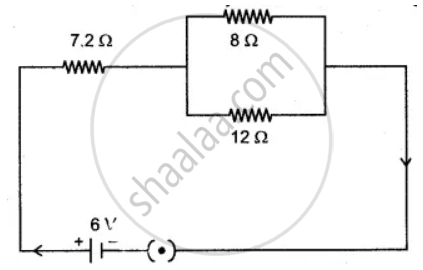
Calculate:
(i) the equivalent resistance of the circuit.
(ii) total current in the circuit.
(iii) potential difference across the 7.2 Ω resistor.
Five resistors of different resistances are connected together as shown in the figure. A 12 V battery is connected to the arrangement.
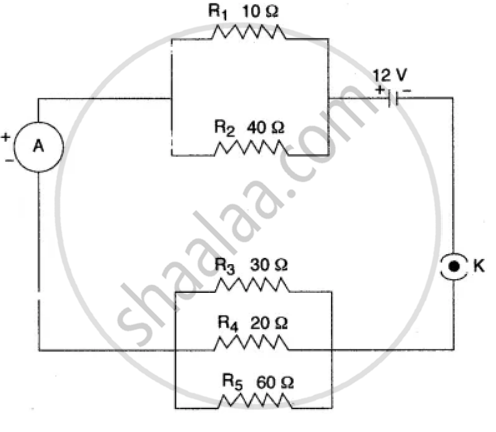
Calculate:
(i) the total resistance in the circuit
(ii) the total current flowing in the circuit.
