Advertisements
Advertisements
Question
An electric bulb draws 0.5 A current at 3.0 V. Calculate the resistance of the filament of the bulb.
Advertisements
Solution
I = 0.5 A, V = 3.0 V
Resistance of filament of the bulb R = `"V"/"I" = 3.0/0.5 = 6 Omega`
RELATED QUESTIONS
The p.d. across a lamp is 12 V. How many joules of electrical energy are changed into heat and light when:
a charge of 1 C passes through it?
What is Ohm's law? Explain how it is used to define the unit of resistance.
If the potential difference between the end of a wire of fixed resistance is doubled, by how much does the electric power increase?
How is the electric potential difference between the two points defined? State its S.I. unit.
What would you suggest to a student if while performing an experiment he finds that the pointer/needle of the ammeter and voltmeter do not coincide with the zero marks on the scales when the circuit is open? No extra ammeter/voltmeter is available in the laboratory.
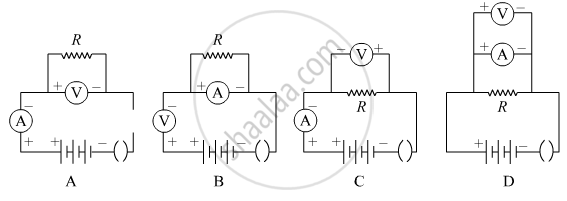
Which one of the following is the correct set-up for studying the dependence of the current on the potential difference across a resistor and why?
Three resistors are connected to a 12 V battery as shown in the figure given below:
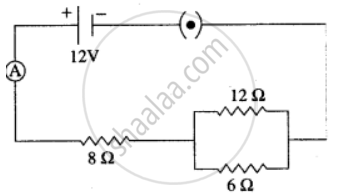
(i) What is the current through the 8 ohm resistor?
(ii) What is the potential difference across the parallel combination of 6 ohm and 12 ohm resistor?
(iii) What is the current through the 6 ohm resistor?
An electric charge always flows from a point at a ______ to a point at a ______.
______ is work done per unit charge.
Study the following circuit and find:

- Effective resistance of the circuit
- Current drawn from the battery
- Potential difference across the 5 omega resistor
