Advertisements
Advertisements
Question
Calculate the quantity of heat produced in a 20 Ω resistor carrying 2.5 A current in 5 minutes.
Advertisements
Solution
Given : R = 20Ω, I = 2.5 A
t = 5 minutes = 5 x 60 = 300 s
Quantity of heat produced is given as
H = I2Rt
= (2.5)2 x 20 x 300
∴ H = 37500 J
APPEARS IN
RELATED QUESTIONS
The values of current (I) flowing through a given resistor of resistance (R), for the corresponding values of potential difference (V) across the resistor are as given below:
| V (volts) | 0.5 | 1.0 | 1.5 | 2.0 | 2.5 | 3.0 | 4.0 | 5.0 |
| I (amperes) | 0.1 | 0.2 | 0.3 | 0.4 | 0.5 | 0.6 | 0.8 | 1.0 |
Plot a graph between current (I) and potential difference (V) and determine the resistance (R) of the resistor.
Which of the following statements correctly defines a volt?
(a) a volt is a joule per ampere.
(b) a volt is a joule per coulomb.
Calculate the work done in moving a charge of 4 coulombs from a point at 220 volts to another point at 230 volts.
Keeping the potential difference constant, the resistance of a circuit is doubled. The current will become:
How is the electric potential difference between the two points defined? State its S.I. unit.
The following table shows current in Amperes and potential difference in Volts.
Which law will the graph prove? Explain the law.
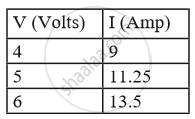
State Ohm’s law.
A battery of 10 volt carries 20,000 C of charge through a resistance of 20 Ω. The work done in 10 seconds is:
100 J of heat is produced each second in a 4 Ω resistor. The potential difference across the resistor will be:
Find out the following in the electric circuit given in Figure
- Effective resistance of two 8 Ω resistors in the combination
- Current flowing through 4 Ω resistor
- Potential difference across 4 Ω resistance
- Power dissipated in 4 Ω resistor
- Difference in ammeter readings, if any.

