Advertisements
Advertisements
प्रश्न
An electric bulb draws 0.5 A current at 3.0 V. Calculate the resistance of the filament of the bulb.
Advertisements
उत्तर
I = 0.5 A, V = 3.0 V
Resistance of filament of the bulb R = `"V"/"I" = 3.0/0.5 = 6 Omega`
संबंधित प्रश्न
You have three resistors of values 2Ω, 3Ω and 5Ω. How will you join them so that the total resistance is more than 7Ω?
1) Draw a diagram for the arrangement
2) Calculate the equivalent resistance.
The p.d. across a lamp is 12 V. How many joules of electrical energy are changed into heat and light when:
a charge of 5 C passes through it?
How does the resistance of a metallic wire depend on its temperature? Explain with reason.
A current of 0.2 A flows through a wire whose ends are at a potential difference of 15 V. Calculate:
(i) The resistance of the wire, and
(ii) The heat energy produced in 1 minute.
Write an expression for the electrical power spent in flow of current through a conductor in terms of resistance and potential difference.
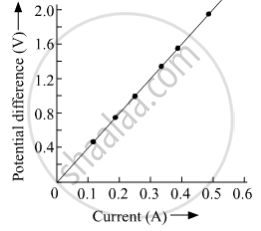
A V-I graph for a nichrome wire is given below. What do you infer from this graph? Draw a labelled circuit diagram to obtain such a graph.
A current of 100 mA. flows through a wire. The charge on an electron is 1.6 × 10⁻¹⁹ C. Find the number of electrons passing per second through the cross-section of the conductor.
Assertion (A): Charges flow from higher potential to lower potential.
Reason (R): Current flows mainly due to the flow of electrons.
What does the positive and negative sign of potential convey?
