Advertisements
Advertisements
प्रश्न
How does the resistance of a metallic wire depend on its temperature? Explain with reason.
Advertisements
उत्तर १
With the increase in temperature of conductor, both the random motion of electrons and the amplitude of vibration of fixed positive ions increase. As a result, the number of collisions increases. Hence, the resistance of a conductor increases with the increase in its temperature. The resistance of filament of a bulb is more when it is glowing (i.e., when it is at a high temperature) as compared to when it is not glowing (i.e., when it is cold).
उत्तर २
The resistance of a metallic wire increases with increase in its temperature.
APPEARS IN
संबंधित प्रश्न
State whether the resistivity of a wire changes with the change in the thickness of the wire.
What do the letters p.d. stand for?
What is the SI unit of potential difference?
The potential difference between the terminals of an electric iron is 240 V and the current is 5.0 A. What is the resistance of the electric iron?
A current of 200 mA flows through a 4 kΩ resistor. What is the p.d. across the resistor?
The V-I graph for a series combination and for a parallel combination of two resistors is shown in Fig – 8.38. Which of the two, A or B, represents the parallel combination? Give a reason for your answer.
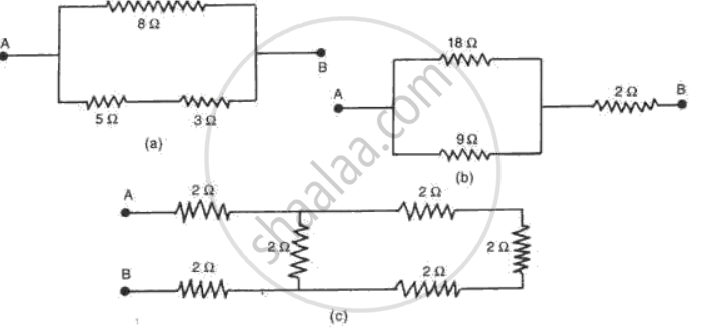
What is the combined resistance of each of the networks between A and B shown in fig. ?
A current of 0.2 A flows through a conducting wire for 5 minutes. How much charge will flow?
A current of 100 mA. flows through a wire. The charge on an electron is 1.6 × 10⁻¹⁹ C. Find the number of electrons passing per second through the cross-section of the conductor.
