Advertisements
Advertisements
प्रश्न
Advertisements
उत्तर
Work done = charge x potential difference
Or, W = 5 x 1 = 5 J
APPEARS IN
संबंधित प्रश्न
What is meant by saying that the potential difference between two points is 1 V?
Potential difference is measured in _________ by using a ___________ placed in ___________ across a component.
Calculate the work done in moving a charge of 4 coulombs from a point at 220 volts to another point at 230 volts.
Name a device that help to measure the potential difference across a conductor.
Why do electricians wear rubber hand gloves while working with electricity?
Write down the formula which states the relation between potential difference, current, and resistance.
100 joules of heat is produced per second in a 4 ohm resistor. What is the potential difference across the resistor?
A current of 0.2 A flows through a wire whose ends are at a potential difference of 15 V. Calculate:
(i) The resistance of the wire, and
(ii) The heat energy produced in 1 minute.
Five resistors of different resistances are connected together as shown in the figure. A 12 V battery is connected to the arrangement.
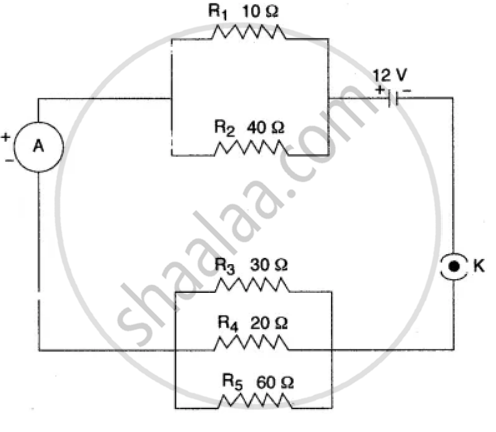
Calculate:
(i) the total resistance in the circuit
(ii) the total current flowing in the circuit.
Find out the following in the electric circuit given in Figure
- Effective resistance of two 8 Ω resistors in the combination
- Current flowing through 4 Ω resistor
- Potential difference across 4 Ω resistance
- Power dissipated in 4 Ω resistor
- Difference in ammeter readings, if any.

