Advertisements
Advertisements
Question
Advertisements
Solution
Work done = charge x potential difference
Or, W = 5 x 1 = 5 J
APPEARS IN
RELATED QUESTIONS
State the relation between potential difference, work done and charge moved.
Name the law which relates the current in a conductor to the potential difference across its ends.
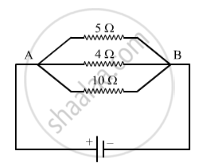
In the circuit diagram given below, the current flowing across 5 ohm resistor is 1 amp. Find the current flowing through the other two resistors.
100 joules of heat is produced per second in a 4 ohm resistor. What is the potential difference across the resistor?
State the S.I. unit of electric potential.
The differences between the electrostatic potential of the positive and the negative end of an electric cell is the ______ of the cell.
The device used for measuring potential difference is
What do you understand by the resistance of a wire?
Two bulbs are marked 100 W, 220 V and 60 W, 110 V. Calculate the ratio of their resistances.
State Ohm’s law.
