Advertisements
Advertisements
Question
The differences between the electrostatic potential of the positive and the negative end of an electric cell is the ______ of the cell.
Advertisements
Solution
The differences between the electrostatic potential of the positive and the negative end of an electric cell is the potential difference of the cell.
Explanation:
This represents the electrical pressure difference between the two terminals of the cell. It determines how much energy is supplied to the electric charges to move them through a circuit. Without this potential difference, electric current cannot flow.
RELATED QUESTIONS
Define one coulomb charge.
State whether a voltmeter has a high resistance of a low resistance. Give reason for your answer.
The p.d. across a lamp is 12 V. How many joules of electrical energy are changed into heat and light when: a current of 2 A flows through it for 10 s?
If the potential difference between the end of a wire of fixed resistance is doubled, by how much does the electric power increase?
Point out two differences between e.m.f. and potential difference as applied to electric circuits.
In the figure given below, A, B and C are three ammeters. The ammeter B reads 0.5A. (All the ammeters have negligible resistance.)
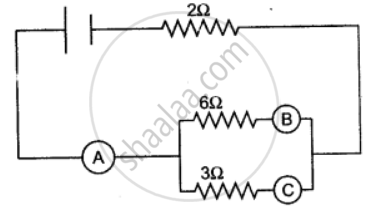
Calculate:
(i) the readings in the ammeters A and C.
(ii) the total resistance of the circuit.
Conceptual question.
A bird sitting on a high power electric line is still safe. How?
Exercise.
Calculate the amount of charge that would flow in 2 hours through an element of an electric bulb drawing a current of 2.5 A.
Name a device that helps to maintain a potential difference across conductors.
What is the measure of the work done on the unit positive charge to bring it to that point against all electrical forces?
