Advertisements
Advertisements
प्रश्न
What is Ohm's law? Explain how it is used to define the unit of resistance.
Advertisements
उत्तर
According to Ohm's law, the current (I) flowing through a wire is directly proportional to the potential difference (V) across it, provided its temperature remains the same.
Thus I α V.
V / I = Constant = R
V = IR
Here R is the resistance.
The unit of resistance is ohm (Ω).
One ohm (Ω) is the resistance of a conductor when a potential difference of one volt is applied to its ends and a current of one ampere flows through it.
संबंधित प्रश्न
Name a device that helps to maintain a potential difference across a conductor.
Which of the following statements correctly defines a volt?
(a) a volt is a joule per ampere.
(b) a volt is a joule per coulomb.
State the relation between potential difference, work done and charge moved.
Name a device which helps to maintain potential difference across a conductor (say, a bulb).
The other name of potential difference is:
Name the law which relates the current in a conductor to the potential difference across its ends.
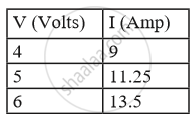
The following table shows current in Amperes and potential difference in Volts.
What will be the nature of the graph between the current and potential difference? (Do not draw a graph.)
The voltage across a 3Ω resistance is 6 V. How large is the current? What is
the resistance of a filament lamp when a voltage of 3 V across it causes a
current of 0.5 A?
Find the resistance of a conductor if the electric current flowing through it is 0.35 A when the potential difference across it is 1.4 V.
