Advertisements
Advertisements
प्रश्न
The voltage across a 3Ω resistance is 6 V. How large is the current? What is
the resistance of a filament lamp when a voltage of 3 V across it causes a
current of 0.5 A?
Advertisements
उत्तर
If voltage, V = 6 volt and resistance R = 3Ω
The a/c to ohm's law, current I = `"V"/"R" = 6/3 = 2 "A"`
For filament lamp:
Given that, voltage= 3 V, current= 0.5 A.
let R be the resistance of the filament lamp;
then R = `"V"/"I" = 3/0.5` = 6Ω
APPEARS IN
संबंधित प्रश्न
What is meant by saying that the potential difference between two points is 1 V?
A battery of emf 12 V and internal resistance 2 Ω is connected with two resistors A and B of resistance 4 Ω and 6 Ω respectively joined in series.
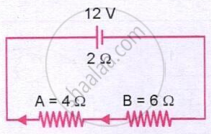
Find:
- Current in the circuit.
- The terminal voltage of the cell.
- The potential difference across 6Ω Resistor.
- Electrical energy spent per minute in the 4Ω resistor.
Name a device that help to measure the potential difference across a conductor.
The p.d. across a lamp is 12 V. How many joules of electrical energy are changed into heat and light when:
a charge of 1 C passes through it?
In the circuit shown below:
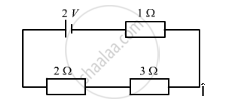
The potential difference across the 3 Ω resistor is:
Two bulbs are marked 100 W, 220 V and 60 W, 110 V. Calculate the ratio of their resistances.
A 10 m long wire of a particular material is of resistance 5Ω What will be the resistance of 10m long wire of the same material but the double radius.
Conceptual question.
A bird sitting on a high power electric line is still safe. How?
Assertion (A): Charges flow from higher potential to lower potential.
Reason (R): Current flows mainly due to the flow of electrons.
Two charged spherical conductors of radius R1 and R2 are connected by a wire. Then the ratio of surface charge densities of the spheres `(σ_1//σ_2 )` is ______.
