Advertisements
Advertisements
Question
The voltage across a 3Ω resistance is 6 V. How large is the current? What is
the resistance of a filament lamp when a voltage of 3 V across it causes a
current of 0.5 A?
Advertisements
Solution
If voltage, V = 6 volt and resistance R = 3Ω
The a/c to ohm's law, current I = `"V"/"R" = 6/3 = 2 "A"`
For filament lamp:
Given that, voltage= 3 V, current= 0.5 A.
let R be the resistance of the filament lamp;
then R = `"V"/"I" = 3/0.5` = 6Ω
APPEARS IN
RELATED QUESTIONS
State whether the resistivity of a wire changes with the change in the thickness of the wire.
What do you understand by the term "potential difference"?
The p.d. across a lamp is 12 V. How many joules of electrical energy are changed into heat and light when:
a charge of 5 C passes through it?
Keeping the potential difference constant, the resistance of a circuit is doubled. The current will become:
Calculate the potential difference between the two terminals of a battery if 100 joules of work is required to transfer 20 coulombs of charge from one terminal of the battery to the other.
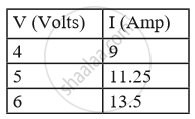
The following table shows current in Amperes and potential difference in Volts.
Which law will the graph prove? Explain the law.
Point out two differences between e.m.f. and potential difference as applied to electric circuits.
Define electric potential and potential difference.
A cylindrical conductor of length l and uniform area of cross section A has resistance R. Another conductor of length 2l and resistance R of the same material has area of cross section.
Name a device that helps to maintain a potential difference across conductors.
