Advertisements
Advertisements
प्रश्न
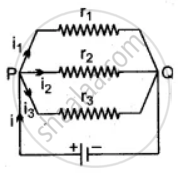
Suppose there are three resistors A, B, and C having resistances r1, r2, and r3 respectively. If R represents their equivalent resistance, establish the following relation `1/"R" = 1/"r"_1 + 1/"r"_2 + 1/"r"_3`, when joined in parallel.
Advertisements
उत्तर
When joined in parallel, let the main current be i which sub-divides at P into i1 in r1, i2 in r2 and i3 in r3 respectively in given figure.
If potential difference across PQ be V then,
According to Ohm's law:
i1 = Vr1 ...(i)
i2 = Vr2 ....(ii)
and i3 = Vr3 ...(iii)
If R'' be the equivalent resistance of this combination, then
i = `"V"/"R''"` ....(A)
From (i), (ii) and (iii) on adding, we get ....(B)
i = i1 + i2 + i3
`= "V"/"r"_1 + "V"/"r"_2 + "V"/"r"_3`
`= "V"(1/"r"_1 + 1/"r"_2 + 1/"r"_3)`
Comparing (A) and (B)
`"V"/"R''" = "V"(1/"r"_1 + 1/"r"_2 + 1/"r"_3)`
or `1/"R''" = 1/"r"_1 + 1/"r"_2 + 1/"r"_3`
संबंधित प्रश्न
The unit for measuring potential difference is ______.
Name the law which relates the current in a conductor to the potential difference across its ends.
Keeping the potential difference constant, the resistance of a circuit is halved. By how much does the current change?
Define the term ‘volt’.
The voltage across a 3Ω resistance is 6 V. How large is the current? What is
the resistance of a filament lamp when a voltage of 3 V across it causes a
current of 0.5 A?
A current of 100 mA. flows through a wire. The charge on an electron is 1.6 × 10⁻¹⁹ C. Find the number of electrons passing per second through the cross-section of the conductor.
A 10 m long wire of a particular material is of reistance 5Ω What will be the resistance of 5m long wire of same material and the same thickness.
Define electric potential and potential difference.
Electric potential is a measure of the ______ on the unit positive charge to bring it to that point against all electrical forces.
What does the positive and negative sign of potential convey?
