Advertisements
Advertisements
Question
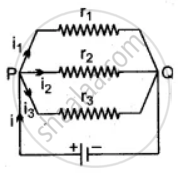
Suppose there are three resistors A, B, and C having resistances r1, r2, and r3 respectively. If R represents their equivalent resistance, establish the following relation `1/"R" = 1/"r"_1 + 1/"r"_2 + 1/"r"_3`, when joined in parallel.
Advertisements
Solution
When joined in parallel, let the main current be i which sub-divides at P into i1 in r1, i2 in r2 and i3 in r3 respectively in given figure.
If potential difference across PQ be V then,
According to Ohm's law:
i1 = Vr1 ...(i)
i2 = Vr2 ....(ii)
and i3 = Vr3 ...(iii)
If R'' be the equivalent resistance of this combination, then
i = `"V"/"R''"` ....(A)
From (i), (ii) and (iii) on adding, we get ....(B)
i = i1 + i2 + i3
`= "V"/"r"_1 + "V"/"r"_2 + "V"/"r"_3`
`= "V"(1/"r"_1 + 1/"r"_2 + 1/"r"_3)`
Comparing (A) and (B)
`"V"/"R''" = "V"(1/"r"_1 + 1/"r"_2 + 1/"r"_3)`
or `1/"R''" = 1/"r"_1 + 1/"r"_2 + 1/"r"_3`
RELATED QUESTIONS
How is a voltmeter connected in the circuit to measure the potential difference between two points? Explain with the help of a diagram.
A current of 1.6 mA flows through a conductor. If charge on an electron is –1.6 × 10⁻¹⁹ coulomb, find the number of electrons that will pass each second through the cross section of that conductor.
The differences between the electrostatic potential of the positive and the negative end of an electric cell is the ______ of the cell.
Draw a graph of Potential difference (V) versus Current (I) for an ohmic resistor. How can you find the resistance of the resistor from this graph?
From the following observations taken while determining the resistance of a conductor, draw the current-voltage graph and calculate the resistance of conductor. Is the conductor ohmic?
| Ammeter reading I (in ampere) | Voltmeter reading V (in volt) |
| 0.2 | 0.4 |
| 0.3 | 0.6 |
| 0.5 | 1.0 |
| 0.8 | 1.6 |
| 1.5 | 3.0 |
A cell of e.m.f 2.0 V and internal resistance 1Ω is connected to the resistors of 3Ω and 6Ω in series. Calculate:
(i) the current drawn from the cell,
(ii) the p.d. across each resistor,
(iii) the terminal voltage of the cell and
(iv) the voltage drop.
A 10 m long wire of a particular material is of resistance 5Ω What will be the resistance of 10m long wire of the same material but the double radius.
Define electric potential and potential difference.
If P and V are the power and potential of device, the power consumed with a supply potential V1 is:
______ is work done per unit charge.
