Advertisements
Advertisements
Question
Explain why potential difference is always less than the e.m.f. of a cell?
Advertisements
Solution
When a cell is in closed circuit, i.e., when current is drawn from it, then the potential difference between its electrodes is called the terminal voltage. It is always less than the e.m.f. because when charge flows in a circuit, some energy is spent in the flow of charge through the electrolyte of the cell.
RELATED QUESTIONS
You have three resistors of values 2Ω, 3Ω and 5Ω. How will you join them so that the total resistance is more than 7Ω?
1) Draw a diagram for the arrangement
2) Calculate the equivalent resistance.
State whether the resistivity of a wire changes with the change in the thickness of the wire.
Keeping the resistance constant, the potential difference applied across the ends of a component is halved. By how much does the current change?
Calculate the power used in the 2 Ω resistor in each of the following circuits: a 6 V battery in series with 1 Ω and 2 Ω resistors.
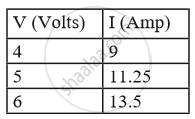
The following table shows current in Amperes and potential difference in Volts.
Which law will the graph prove? Explain the law.
From the following observations taken while determining the resistance of a conductor, draw the current-voltage graph and calculate the resistance of conductor. Is the conductor ohmic?
| Ammeter reading I (in ampere) | Voltmeter reading V (in volt) |
| 0.2 | 0.4 |
| 0.3 | 0.6 |
| 0.5 | 1.0 |
| 0.8 | 1.6 |
| 1.5 | 3.0 |
Three resistors are connected to a 6 V battery as shown in the figure given below:
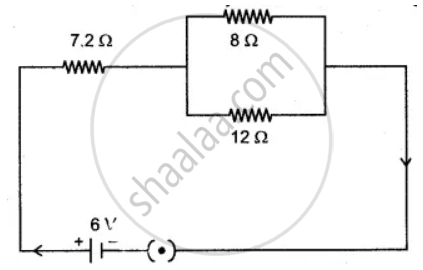
Calculate:
(i) the equivalent resistance of the circuit.
(ii) total current in the circuit.
(iii) potential difference across the 7.2 Ω resistor.
Five resistors of different resistances are connected together as shown in the figure. A 12 V battery is connected to the arrangement.
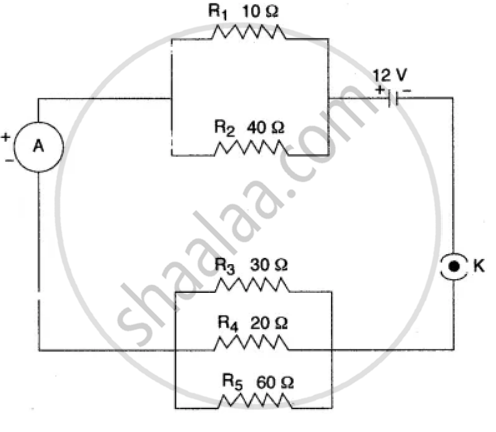
Calculate:
(i) the total resistance in the circuit
(ii) the total current flowing in the circuit.
Electric potential is a ____________.
A negative charge will move from ______ to ______ potential.
