Advertisements
Advertisements
प्रश्न
Explain why potential difference is always less than the e.m.f. of a cell?
Advertisements
उत्तर
When a cell is in closed circuit, i.e., when current is drawn from it, then the potential difference between its electrodes is called the terminal voltage. It is always less than the e.m.f. because when charge flows in a circuit, some energy is spent in the flow of charge through the electrolyte of the cell.
संबंधित प्रश्न
What is meant by saying that the potential difference between two points is 1 V?
The unit for measuring potential difference is ______.
The p.d. across a lamp is 12 V. How many joules of electrical energy are changed into heat and light when:
a charge of 5 C passes through it?
Ohm's law state a relation between potential difference and ___________.
b. The values of potential difference V applied across a resistor and the correponding values of current I flowing in the resistor are given below:
| Potential difference, V (in volts) | : | 2.5 | 5.0 | 10.0 | 15.0 | 20.0 | 25.0 |
| Current, I (in amperes) | : | 0.1 | 0.2 | 0.4 | 0.6 | 0.8 | 1.0 |
Plot a graph between V and I, and calculate the resistance of the resistor.
c. Name the law which is illustrated by the above V-I graph.
Keeping the potential difference constant, the resistance of a circuit is doubled. The current will become:
The V-I graph for a series combination and for a parallel combination of two resistors is shown in Fig – 8.38. Which of the two, A or B, represents the parallel combination? Give a reason for your answer.
Write proper word from the following group of words in the blank.
(magnetism, 4.5V, 3.0V, gravitational attraction, potential difference, potential, higher, lower, 0V)
Water in the waterfall flows from a higher level to the lower level because of ______.
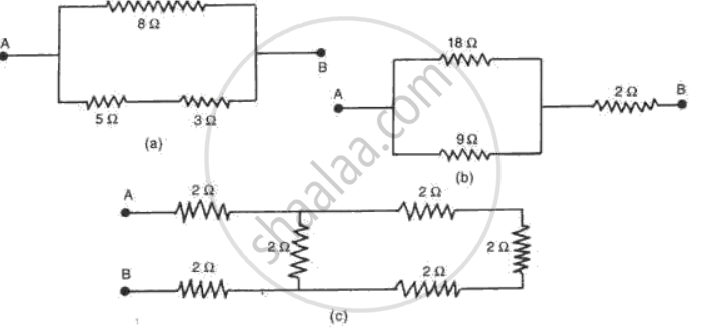
What is the combined resistance of each of the networks between A and B shown in fig. ?
If P and V are the power and potential of device, the power consumed with a supply potential V1 is:
