Advertisements
Advertisements
प्रश्न
Define the unit of resistance (or Define the unit "ohm").
Advertisements
उत्तर
One ohm (Ω) is the resistance of a conductor when a potential difference of one volt is applied to its ends and a current of one ampere flows through it.
APPEARS IN
संबंधित प्रश्न
You have three resistors of values 2Ω, 3Ω and 5Ω. How will you join them so that the total resistance is more than 7Ω?
1) Draw a diagram for the arrangement
2) Calculate the equivalent resistance.
State whether a voltmeter has a high resistance of a low resistance. Give reason for your answer.
Calculate the power used in the 2 Ω resistor in each of the following circuits: a 4 V battery in parallel with 12 Ω and 2 Ω resistors.
Electric cells having 2V potential difference each have been connected in the form of a battery. What will be the total potential difference of the battery in both cases?


Which one of the following is the correct set-up for studying the dependence of the current on the potential difference across a resistor and why?
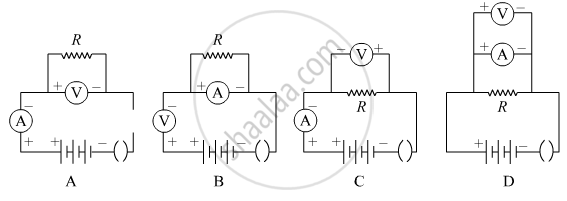
What do you understand by the resistance of a wire?
From the following observations taken while determining the resistance of a conductor, draw the current-voltage graph and calculate the resistance of conductor. Is the conductor ohmic?
| Ammeter reading I (in ampere) | Voltmeter reading V (in volt) |
| 0.2 | 0.4 |
| 0.3 | 0.6 |
| 0.5 | 1.0 |
| 0.8 | 1.6 |
| 1.5 | 3.0 |
Two bulbs are marked 100 W, 220 V and 60 W, 110 V. Calculate the ratio of their resistances.
The SI unit of potential difference is ______.
Twenty-seven drops of same size are charged at 220 V each. They combine to form a bigger drop. Calculate the potential of the bigger drop.
