Advertisements
Advertisements
प्रश्न
Define the unit of resistance (or Define the unit "ohm").
Advertisements
उत्तर
One ohm (Ω) is the resistance of a conductor when a potential difference of one volt is applied to its ends and a current of one ampere flows through it.
APPEARS IN
संबंधित प्रश्न
What is the SI unit of potential difference?
A current of 200 mA flows through a 4 kΩ resistor. What is the p.d. across the resistor?
For the circuit shown in the diagram below:
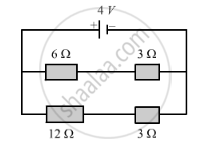
What is the value of:
(i) current through 6 Ω resistor?
(ii) potential difference across 12 Ω resistor?
Calculate the potential difference between the two terminals of a battery if 100 joules of work is required to transfer 20 coulombs of charge from one terminal of the battery to the other.
Three resistors are connected to a 12 V battery as shown in the figure given below:
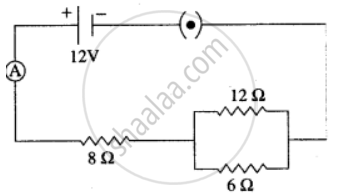
(i) What is the current through the 8 ohm resistor?
(ii) What is the potential difference across the parallel combination of 6 ohm and 12 ohm resistor?
(iii) What is the current through the 6 ohm resistor?
Suppose there are three resistors A, B, and C having resistances r1, r2, and r3 respectively. If R represents their equivalent resistance, establish the following relation `1/"R" = 1/"r"_1 + 1/"r"_2 + 1/"r"_3`, when joined in parallel.
A cell of e.m.f 2.0 V and internal resistance 1Ω is connected to the resistors of 3Ω and 6Ω in series. Calculate:
(i) the current drawn from the cell,
(ii) the p.d. across each resistor,
(iii) the terminal voltage of the cell and
(iv) the voltage drop.
Name a device that helps to maintain a potential difference across conductors.
