Advertisements
Advertisements
प्रश्न
Advertisements
उत्तर
We know that,
P=VI= I1R
Given, P = 1200 watt , I= 5A
R = `"P"/"I"^2 = 1200/(5 xx 5) = 48 Omega`
and, V = `"P"/"I" = 1200/5` = 240 V
APPEARS IN
संबंधित प्रश्न
What do the letters p.d. stand for?
How much work is done when one coulomb charge moves against a potential difference of 1 volt?
How much work is done in moving a charge of 2 C across two points having a potential difference of 12 V?
For the circuit shown in the diagram below:
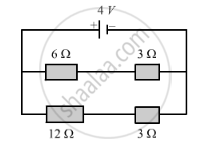
What is the value of:
(i) current through 6 Ω resistor?
(ii) potential difference across 12 Ω resistor?
Calculate the power used in the 2 Ω resistor in each of the following circuits: a 6 V battery in series with 1 Ω and 2 Ω resistors.
State the S.I. unit of electric potential.
How does the resistance of a metallic wire depend on its temperature? Explain with reason.
Define the following:
Potential difference
Twenty-seven drops of same size are charged at 220 V each. They combine to form a bigger drop. Calculate the potential of the bigger drop.
