Advertisements
Advertisements
Question
What is Ohm's law? Explain how it is used to define the unit of resistance.
Advertisements
Solution
According to Ohm's law, the current (I) flowing through a wire is directly proportional to the potential difference (V) across it, provided its temperature remains the same.
Thus I α V.
V / I = Constant = R
V = IR
Here R is the resistance.
The unit of resistance is ohm (Ω).
One ohm (Ω) is the resistance of a conductor when a potential difference of one volt is applied to its ends and a current of one ampere flows through it.
RELATED QUESTIONS
Define the unit of resistance (or Define the unit "ohm").
What is the ratio of potential difference and current known as?
b. The values of potential difference V applied across a resistor and the correponding values of current I flowing in the resistor are given below:
| Potential difference, V (in volts) | : | 2.5 | 5.0 | 10.0 | 15.0 | 20.0 | 25.0 |
| Current, I (in amperes) | : | 0.1 | 0.2 | 0.4 | 0.6 | 0.8 | 1.0 |
Plot a graph between V and I, and calculate the resistance of the resistor.
c. Name the law which is illustrated by the above V-I graph.
Calculate the current flowing through each of the resistors A and B in the circuit shown in the following figure.
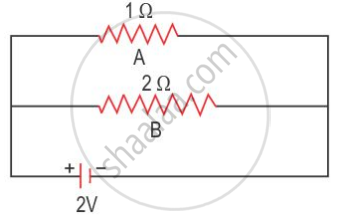
Two bulbs are marked 100 W, 220 V and 60 W, 110 V. Calculate the ratio of their resistances.
A 10 m long wire of a particular material is of reistance 5Ω What will be the resistance of 5m long wire of same material and the same thickness.
Conceptual question.
Does a solar cell always maintain the potential across its terminals constant? Discuss
Find out the following in the electric circuit given in Figure
- Effective resistance of two 8 Ω resistors in the combination
- Current flowing through 4 Ω resistor
- Potential difference across 4 Ω resistance
- Power dissipated in 4 Ω resistor
- Difference in ammeter readings, if any.

Assertion (A): Charges flow from higher potential to lower potential.
Reason (R): Current flows mainly due to the flow of electrons.
A negative charge will move from ______ to ______ potential.
