Advertisements
Advertisements
प्रश्न
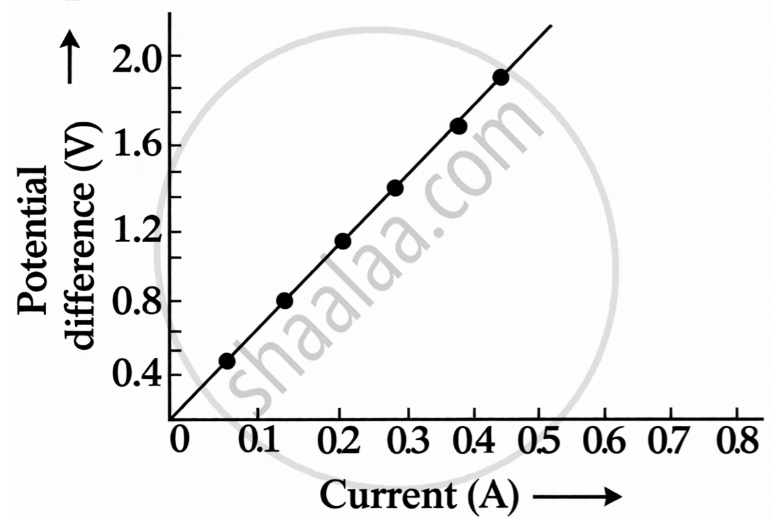
State the relation correlating the electric current flowing in a conductor and the voltage applied across it. Also, draw a graph to show this relationship.
Advertisements
उत्तर
The flow of current (I) in the conductor is directly proportional to the potential diffidence (V) established across it provided the physical conditions remain same.
V is directly proportional to I
V = IR This is called as Ohm’s law.
APPEARS IN
संबंधित प्रश्न
Write the SI unit of resistivity
Four resistances of 16 ohms each are connected in parallel. Four such combinations are connected in series. What is the total resistance?
An electric bulb draws 1.2 A current at 6.0 V. Find the resistance of filament of bulb while glowing.
- Name and state the law which relates the potential difference and current in a conductor.
- What is the necessary condition for a conductor to obey the law named above in part (a) ?
An ammeter placed in series with an electric radiator reads 0.5 amps and a voltmeter placed across it reads 230 volts. What is the resistance of the radiator?
The unit of specific resistance is ____________.
Assertion: The statement of Ohm’s law is K = IR.
Reason: V = IR is the equation which defines resistance.
A current of 2amp flowing through a conductor produced 80 joule of heat in 10 sec. The resistance of the conductor is:-
In the context of Ohm's Law, Current (I) is defined as:
The electric current between two joined conductors at different potentials continues to flow until:
