Advertisements
Advertisements
प्रश्न
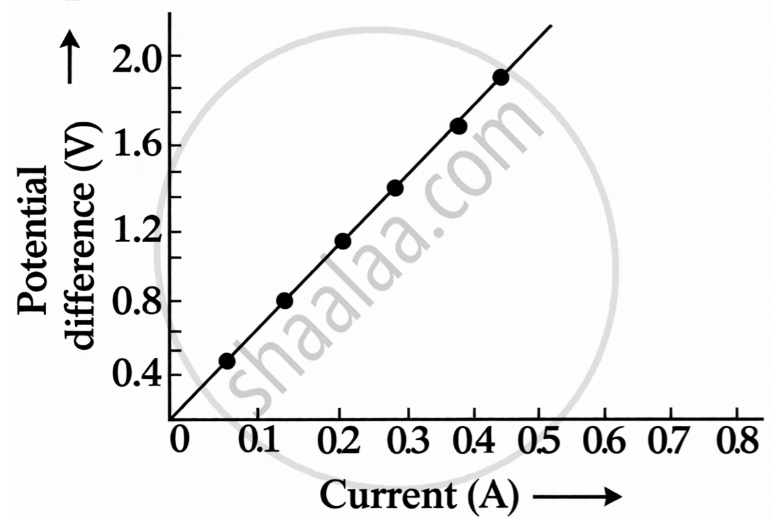
State the relation correlating the electric current flowing in a conductor and the voltage applied across it. Also, draw a graph to show this relationship.
Advertisements
उत्तर
The flow of current (I) in the conductor is directly proportional to the potential diffidence (V) established across it provided the physical conditions remain same.
V is directly proportional to I
V = IR This is called as Ohm’s law.
APPEARS IN
संबंधित प्रश्न
Find the resistance of a conductor if 0.24 A current is passing through it and a potential difference of 24 V is applied across it.
Why are coils of electric toasters and electric irons made of an alloy rather than a pure metal?
What is an Ohmic resistor?
The unit of electrical resistance is:
(a) ampere
(b) volt
(c) coulomb
(d) ohm
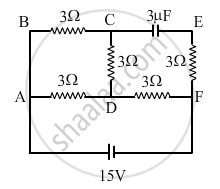
In the circuit shown in the figure, find the total resistance of the circuit and the current in the arm AD.
What are non-ohmic conductors? Give one exmaple. Draw a current-voltage graph for a non-ohmic conductor.
Ohm’s law states the relationship between power and voltage.
Assertion: The statement of Ohm’s law is K = IR.
Reason: V = IR is the equation which defines resistance.
A metal rod of length 10 cm and a rectangular cross-section of 1 cm × `1/2` cm is connected to a battery across opposite faces. The resistance will be ______.
Which of the following describes the V-I relation for an Ohmic conductor?
