Advertisements
Advertisements
Question
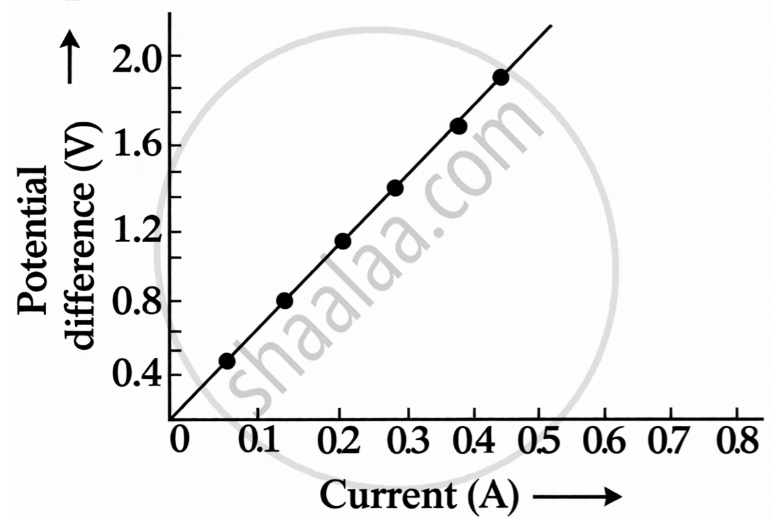
State the relation correlating the electric current flowing in a conductor and the voltage applied across it. Also, draw a graph to show this relationship.
Advertisements
Solution
The flow of current (I) in the conductor is directly proportional to the potential diffidence (V) established across it provided the physical conditions remain same.
V is directly proportional to I
V = IR This is called as Ohm’s law.
APPEARS IN
RELATED QUESTIONS
Write the formula of resistivity
The graph between V and I for a conductor is a straight line passing through the origin.
What should remain constant in a statement of this law?
A wire of resistance 3 ohm and length 10 cm is stretched to length 30 cm. Assuming that it has a uniform cross section, what will be its new resistance?
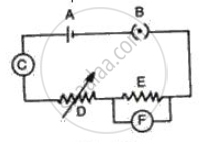
Fig. represents the circuit used for the verification of ohm's law. Label the different parts from A and F. State the function of each.
Rewrite the following statement by selecting the correct option.
The S.I. unit of resistance is __________.
Two cells each of 5V are connected in series across an 8Ω resistor and three parallel resistors of 4Ω, 6Ω, and 12Ω. Draw a circuit diagram for the above arrangement. Calculate
- the current drawn from the cell
- current through each resistor
The voltage - current readings of a certain material are shown in the table given below:
| Voltage (V) | 10 V | 20 V | 30 V |
| Current (I) | 2 A | 3 A | 4 A |
Study the table.
- State whether the conductor used is ohmic or non-ohmic.
- Justify your answer.
- State Ohm's law.
The electric current between two joined conductors at different potentials continues to flow until:
For a continuous current flow through a conductor, what must be maintained across the ends of the conductor?
From Ohm's Law, since \[I \propto V\], the constant ratio \[\frac{V}{I}\] is defined as:
