Advertisements
Advertisements
प्रश्न
Four resistances of 16 ohms each are connected in parallel. Four such combinations are connected in series. What is the total resistance?
Advertisements
उत्तर
When four resistors of 16 Ω each are connected in parallel, the effective resistance of the combination can be obtained as:
`1/R=1/R_1+1/R_2+1/R_3+1/R_4`
or `1/R=1/16+1/16+1/16+1/16`
or `1/R=4/16`
or `1/R=1/4`
or `R=4`Ω
The effective resistance of combination is 4 Î.
When four such combinations are connected in series, the effective resistance becomes:
R = R1 + R2+ R3 + R4
R = 4 Î + 4 Î + 4 Î + 4 Î = 16 Ω
APPEARS IN
संबंधित प्रश्न
Let the resistance of an electrical component remains constant while the potential difference across the two ends of the component decreases to half of its former value. What change will occur in the current through it?
The relationship between the potential difference and the current in a conductor is stated in the form of a law.
- Name the law.
- What does the slope of V-I graph for a conductor represent?
- Name the material used for making the connecting wire.
What is an Ohmic resistor?
When a 12 V battery is connected across an unknown resistor, there is a current of 2.5 mA in the circuit. Calculate the value of the resistance of the resistor.
Ohm's law gives a relationship between:
(a) current and resistance
(b) resistance and potential difference
(c) potential difference and electric charge
(d) current and potential difference
The resistors R1, R2, R3 and R4 in the figure given below are all equal in value.
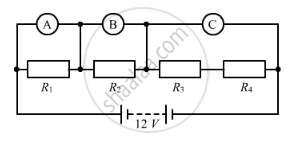
What would you expect the voltmeter A, B and C to read assuming that the connecting wires in the circuit have negligible resistance?
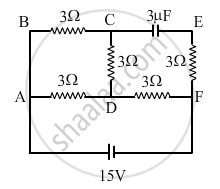
In the circuit shown in the figure, find the total resistance of the circuit and the current in the arm AD.
The filament of a bulb takes a current 100 mA when potential difference across it is 0.2 V. When the potential difference across it becomes 1.0 V, the current becomes 400 mA. Calculate the resistance of filament in each case and account for the difference.
What is meant by the drift speed of free electrons?
SI unit of resistance is:
What is ohmic device?
What is non ohmic device?
Two conductors are made of the same material and have the same length. Conductor A is a solid wire of diameter 1 mm. Conductor B is a hollow tube of outer diameter 2 mm and inner diameter 1 mm. Find the ratio of resistance RA to RB.
Why should an ammeter have low resistance?
A current of 0.8 A flows in a conductor of 40 Ω for 1 minute. The heat produced in the conductor will be ______.

Vinita and Ahmed demonstrated a circuit that operates the two headlights and the two sidelights of a car, in their school exhibition. Based on their demonstrated circuit, answer the following questions.
- State what happens when switch A is connected to:
a) Position 2
b) Position 3 - Find the potential difference across each lamp when lit.
- Calculate the current.
a) in each 12 Ω lamp when lit.
b) In each 4 Ω lamp when lit.
OR - Show, with calculations, which type of lamp, 4.0 Ω or 12 Ω, has the higher power.
Ohm's Law states that for a metallic conductor, the current flowing through it is directly proportional to the potential difference across its ends, provided that:
If a current of 1 A flows through a conductor, then according to Ohm's Law, the resistance of the conductor is:
If the voltage across a conductor is increased while its temperature remains unchanged, what happens to the current flowing through it?
