Advertisements
Advertisements
प्रश्न
Four resistances of 16 ohms each are connected in parallel. Four such combinations are connected in series. What is the total resistance?
Advertisements
उत्तर
When four resistors of 16 Ω each are connected in parallel, the effective resistance of the combination can be obtained as:
`1/R=1/R_1+1/R_2+1/R_3+1/R_4`
or `1/R=1/16+1/16+1/16+1/16`
or `1/R=4/16`
or `1/R=1/4`
or `R=4`Ω
The effective resistance of combination is 4 Î.
When four such combinations are connected in series, the effective resistance becomes:
R = R1 + R2+ R3 + R4
R = 4 Î + 4 Î + 4 Î + 4 Î = 16 Ω
APPEARS IN
संबंधित प्रश्न
If the potential difference across the ends of a conductor is 220 V and the resistance of the conductor is 44 Ω (ohm), then the current flowing through is _________.
- 0.2 A
- 0.5 A
- 2 A
- 5 A
Will current flow more easily through a thick wire or a thin wire of the same material, when connected to the same source? Why?
Write the SI unit of resistivity
An electrical bulb is marked 200V, 100W. Calculate the electrical resistance of its filament. If five such
bulbs are connected in series to a 200V supply, how much current will flow through them?
Find the expression for the resistivity of a material and state the SI unit of resistivity.
State Ohm’s law and draw a neat labelled circuit diagram containing a battery, a key, a voltmeter, an ammeter, a rheostat and an unknown resistance to verify it.
Calculate the current flowing through a wire of resistance 5 Ω connected to a battery of potential difference 3 V.
Fig. represents the circuit used for the verification of ohm's law. Label the different parts from A and F. State the function of each.
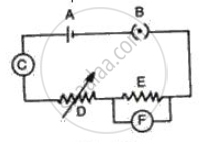
- Name and state the law which relates the potential difference and current in a conductor.
- What is the necessary condition for a conductor to obey the law named above in part (a) ?
State the relation correlating the electric current flowing in a conductor and the voltage applied across it. Also, draw a graph to show this relationship.
SI unit of resistance is:
The ratio of the potential difference to the current is known as ________.
Obtain the macroscopic form of Ohm’s law from its microscopic form and discuss its limitation.
The unit of specific resistance is ____________.
Consider a current carrying wire (current I) in the shape of a circle. Note that as the current progresses along the wire, the direction of j (current density) changes in an exact manner, while the current I remain unaffected. The agent that is essentially responsible for is ______.
A metal rod of length 10 cm and a rectangular cross-section of 1 cm × `1/2` cm is connected to a battery across opposite faces. The resistance will be ______.
The circuit depicted in the figure is employed for studying Ohm’s Law. Instead of using a standard resistor, a student opts for a glass tube filled with mercury (tube 1), connected to the circuit through two electrodes, E1 and E2. He records the readings of the ammeter and voltmeter, thereby calculating the resistance. The student repeats the experiment by substituting tube 1 with tube 2, where the same amount of mercury fills tube 2.
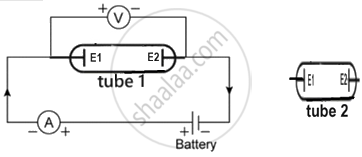
Neglecting internal resistance of the cell use (> or < or =) to compare:
- the resistance in both the cases.
- the voltmeter readings in both the cases.
- the specific resistance in both the cases.
A current of 3.2 mA flows through a conductor. If charge on an electron is −1.6 × 10⁻¹⁹ coulomb, find the number of electrons that will pass each second through the cross section of that conductor.
The electric current between two joined conductors at different potentials continues to flow until:
