Advertisements
Advertisements
प्रश्न
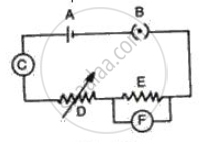
Fig. represents the circuit used for the verification of ohm's law. Label the different parts from A and F. State the function of each.
Advertisements
उत्तर
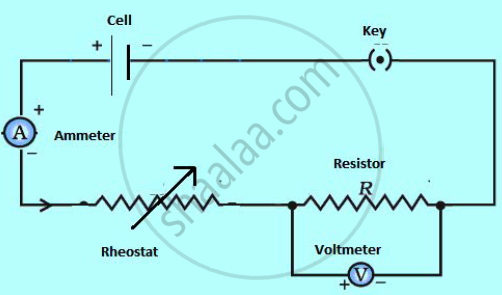
Functions:
(A) Cell- It provides the potential difference in the circuit.
(B) Key- It serves as a switch in the circuit. It supplies or cuts off current as required.
(C) Ammeter - It measures the current in the circuit.
(D) Rheostat- It helps to change the resistance of the circuit without changing its voltage.
(E) Resistor- It provides a constant resistance in the circuit.
(F) Voltmeter - It measure the potential drop across the resistor.
APPEARS IN
संबंधित प्रश्न
Will current flow more easily through a thick wire or a thin wire of the same material, when connected to the same source? Why?
Is Ohm’s law universally applicable for all conducting elements? If not, give examples of elements which do not obey Ohm’s law.
What is Resistivity?
Name the physical quantity whose unit is "ohm".
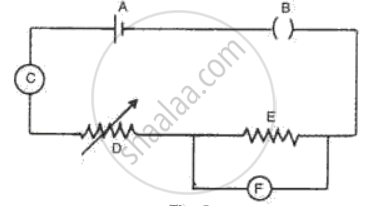
Fig. represents the circuit used for the verification of Ohm's law. Label the parts from A to F. state the function of each.
The filament of a bulb takes a current 100 mA when potential difference across it is 0.2 V. When the potential difference across it becomes 1.0 V, the current becomes 400 mA. Calculate the resistance of filament in each case and account for the difference.
State the relation correlating the electric current flowing in a conductor and the voltage applied across it. Also, draw a graph to show this relationship.
What is non ohmic device?
The unit of specific resistance is ____________.
A current of 2amp flowing through a conductor produced 80 joule of heat in 10 sec. The resistance of the conductor is:-
