Advertisements
Advertisements
प्रश्न
Consider a current carrying wire (current I) in the shape of a circle. Note that as the current progresses along the wire, the direction of j (current density) changes in an exact manner, while the current I remain unaffected. The agent that is essentially responsible for is ______.
पर्याय
source of emf.
electric field produced by charges accumulated on the surface of wire.
the charges just behind a given segment of wire which push them just the right way by repulsion.
the charges ahead.
Advertisements
उत्तर
Consider a current carrying wire (current I) in the shape of a circle. Note that as the current progresses along the wire, the direction of j (current density) changes in an exact manner, while the current I remain unaffected. The agent that is essentially responsible for is electric field produced by charges accumulated on the surface of wire.
Explanation:
Current per unit area (taken normal to the current), I/A, is called current density and is denoted by `vecJ`.

The SI unit of the current density ate A/m2. The current density is also directed along E and which is also a vector quantity and the relationship is given by
`vecJ = σvecE = vecE/ρ`
Where σ = conductivity and ρ = resistivity or specific resistance of the substance.
The `vecJ` changes due to the electric field produced by changes accumulated on the surface of wire.
APPEARS IN
संबंधित प्रश्न
What is Resistivity?
Keeping the p.d. constant, the resistance of a circuit is halved. The current will become:
(a) one-fourth
(b) four time
(c) half
(d) double
Fill in the following blank with suitable words:
Resistance is measured in .............. The resistance of a wire increases as the length ..............; as the temperature ..............; and as the cross-sectional area .............. .
The resistors R1, R2, R3 and R4 in the figure given below are all equal in value.
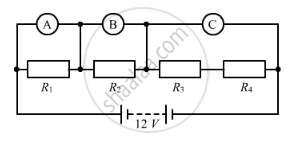
What would you expect the voltmeter A, B and C to read assuming that the connecting wires in the circuit have negligible resistance?
A resistance of 40 ohms and one of 60 ohms are arranged in series across 220 volt supply. Find the heat in joules produced by this combination of resistances in half a minute.
What is an ohmic resistor? Give one example of an ohmic resistor. Draw a graph to show its current voltage relationship. How is the resistance of the resistor determined from this graph?
Which of the following is an ohmic resistance?
Show by a diagram how two resistors R1 and R2 are joined in parallel. Obtain an expression for the total resistance of the combination.
Consider the sacle of voltmeter shown in the diagram and answer the following questions :

(a) What is the least count of the voltmeter?
(b) What is the reading shown by the voltmeter ?
(c) If the voltmeter is connected across a resistor of 20 `Omega` how much current is flowing through the resistor?
Draw a neat diagram for the verification of Ohm’s law by voltmeter-ammeter method. By another diagram show the relation between p.d. and current.
SI unit of resistance is:
The ratio of the potential difference to the current is known as ________.
Ohm’s law states the relationship between power and voltage.
State Ohm’s law? How can it be verified experimentally? Does it hold good under all conditions? Comment.
The heat produced by a 100 w heater in 2 minute is equal to
What is the resistance of a conductor through which a current of 0.5 A flows when a potential difference of 2V is applied across its ends?
Ohm's Law states that for a metallic conductor, the current flowing through it is directly proportional to the potential difference across its ends, provided that:
What is the nature of the graph obtained when potential difference is plotted against current for an Ohmic conductor?
