Advertisements
Advertisements
Question
Consider a current carrying wire (current I) in the shape of a circle. Note that as the current progresses along the wire, the direction of j (current density) changes in an exact manner, while the current I remain unaffected. The agent that is essentially responsible for is ______.
Options
source of emf.
electric field produced by charges accumulated on the surface of wire.
the charges just behind a given segment of wire which push them just the right way by repulsion.
the charges ahead.
Advertisements
Solution
Consider a current carrying wire (current I) in the shape of a circle. Note that as the current progresses along the wire, the direction of j (current density) changes in an exact manner, while the current I remain unaffected. The agent that is essentially responsible for is electric field produced by charges accumulated on the surface of wire.
Explanation:
Current per unit area (taken normal to the current), I/A, is called current density and is denoted by `vecJ`.

The SI unit of the current density ate A/m2. The current density is also directed along E and which is also a vector quantity and the relationship is given by
`vecJ = σvecE = vecE/ρ`
Where σ = conductivity and ρ = resistivity or specific resistance of the substance.
The `vecJ` changes due to the electric field produced by changes accumulated on the surface of wire.
APPEARS IN
RELATED QUESTIONS
Find the expression for the resistivity of a material and state the SI unit of resistivity.
Ohm's law gives a relationship between:
(a) current and resistance
(b) resistance and potential difference
(c) potential difference and electric charge
(d) current and potential difference
How should the two resistances of 2 ohms each be connected so as to produce an equivalent resistance of 1 ohm?
How much energy is consumed when a current of 5 amperes flows through the filament (or element) of a heater having resistance of 100 ohms for two hours? Express it in joules.
A wire has a length of 2.0 m and a resistance of 5.0 Ω. Find the electric field existing inside the wire if it carries a current of 10 A.
A metal sphere is kept on an insulting stands. A negatively charged rod is brought near it, then the sphere is earthed as shown. On removing the earthing, and taking the negatively charged rod away, what will be the nature of charge on the sphere? Give reason for your answer.
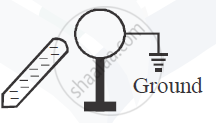
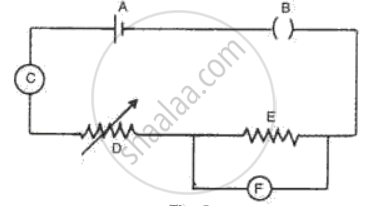
Fig. represents the circuit used for the verification of Ohm's law. Label the parts from A to F. state the function of each.
State the relation correlating the electric current flowing in a conductor and the voltage applied across it. Also, draw a graph to show this relationship.
An ammeter placed in series with an electric radiator reads 0.5 amps and a voltmeter placed across it reads 230 volts. What is the resistance of the radiator?
Choose the correct alternative.
Which of the following is an ohmic conductor?
Define temperature coefficient of resistance.
Write a short note on superconductors?
A heater of 220 V heats a volume of water m 5 mint time. A heater of 110 V heat in ten second. The resistance of the conductor is
A metal rod of length 10 cm and a rectangular cross-section of 1 cm × `1/2` cm is connected to a battery across opposite faces. The resistance will be ______.
The voltage - current readings of a certain material are shown in the table given below:
| Voltage (V) | 10 V | 20 V | 30 V |
| Current (I) | 2 A | 3 A | 4 A |
Study the table.
- State whether the conductor used is ohmic or non-ohmic.
- Justify your answer.
- State Ohm's law.
The circuit depicted in the figure is employed for studying Ohm’s Law. Instead of using a standard resistor, a student opts for a glass tube filled with mercury (tube 1), connected to the circuit through two electrodes, E1 and E2. He records the readings of the ammeter and voltmeter, thereby calculating the resistance. The student repeats the experiment by substituting tube 1 with tube 2, where the same amount of mercury fills tube 2.
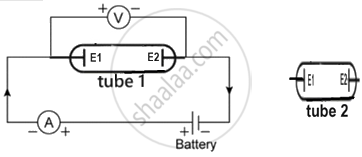
Neglecting internal resistance of the cell use (> or < or =) to compare:
- the resistance in both the cases.
- the voltmeter readings in both the cases.
- the specific resistance in both the cases.
From Ohm's Law, since \[I \propto V\], the constant ratio \[\frac{V}{I}\] is defined as:
Which of the following describes the V-I relation for an Ohmic conductor?
