Advertisements
Advertisements
Question
Let the resistance of an electrical component remains constant while the potential difference across the two ends of the component decreases to half of its former value. What change will occur in the current through it?
Advertisements
Solution
According to Ohm’s law
V = IR
⇒ I = `V/R` …(1)
Now Potential difference is decreased to half
∴ New potential difference `"Vʹ" = V/2`
Resistance remains constant
So the new current `"Iʹ" = "Vʹ"/"R"`
= `(V/2)/R`
= `(1/2) (V/R)`
= `(1/2) I`
= `I/2`
Therefore, the amount of current flowing through the electrical component is reduced by half.
APPEARS IN
RELATED QUESTIONS
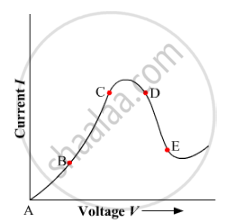
Graph showing the variation of current versus voltage for a material Ga As is shown in the figure. Identify the region of
(i) negative resistance
(ii) where Ohm's law is obeyed.
What is Resistivity?
Find the expression for the resistivity of a material and state the SI unit of resistivity.
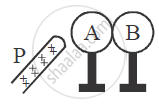
Two metallic spheres A and B kept on insulating stands are in contact with each other. A positively charged rod P is brought near the sphere A as shown in the figure. The two spheres are separated from each other, and the rod P is removed. What will be the nature of charges on spheres A and B?
Consider the sacle of voltmeter shown in the diagram and answer the following questions :

(a) What is the least count of the voltmeter?
(b) What is the reading shown by the voltmeter ?
(c) If the voltmeter is connected across a resistor of 20 `Omega` how much current is flowing through the resistor?
Tick(✓) the correct choice in the following:
Ohm's law is applicable to
Answer the following question.
Distinguish between Ohmic and non-ohmic substances; explain with the help of example.
Ohm’s law states the relationship between power and voltage.
What is non ohmic device?
Which of the following I-V graph represents ohmic conductors?
The slope of voltage (V) versus current (I) is called:

Ohm's law deals with the relationship between ______
State Ohm's Law. Represent it mathematically.
You are provided with a resistor, a key, an ammeter, a voltmeter, four cells of 1.5 V each and few connecting wires. Using circuit components, draw a labelled circuit diagram to show the setup to study Ohm's law.
State the relationship between potential difference (V) across the resistor and the current (I) flowing through it. Also draw V-I graph, taking V on the X-axis.
The resistance of a resistor is reduced to half of its initial value. If other parameters of the electrical circuit remain unaltered, the amount of heat produced in the resistor will become ______.
Which of the following correctly defines Potential Difference (V) as one of the three core quantities of Ohm's Law?
Resistance (R) in a conductor is best described as:
The mathematical form of Ohm's Law is:
The electric current between two joined conductors at different potentials continues to flow until:
