Advertisements
Advertisements
Question
Write a short note on superconductors?
Advertisements
Solution
- The resistance of certain materials becomes zero below a certain temperature, known as critical or transition temperature.
- The materials that exhibit this property are known as superconductors and the phenomenon is known as superconductivity.
APPEARS IN
RELATED QUESTIONS
Name the law which is illustrated by the above V−I graph.
State Ohm’s law and draw a neat labelled circuit diagram containing a battery, a key, a voltmeter, an ammeter, a rheostat and an unknown resistance to verify it.
In the circuit shown below in Fig, calculate the value of x if the equivalent resistance between A and B is 4 Ω.

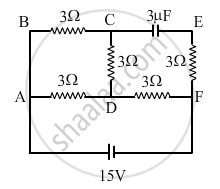
In the circuit shown in the figure, find the total resistance of the circuit and the current in the arm AD.
An ammeter placed in series with an electric radiator reads 0.5 amps and a voltmeter placed across it reads 230 volts. What is the resistance of the radiator?
State microscopic form of Ohm’s law.
Two cells each of 5V are connected in series across an 8Ω resistor and three parallel resistors of 4Ω, 6Ω, and 12Ω. Draw a circuit diagram for the above arrangement. Calculate
- the current drawn from the cell
- current through each resistor
A metal rod of length 10 cm and a rectangular cross-section of 1 cm × `1/2` cm is connected to a battery across opposite faces. The resistance will be ______.
A current of 0.8 A flows in a conductor of 40 Ω for 1 minute. The heat produced in the conductor will be ______.
