Advertisements
Advertisements
Question
Ohm’s law states the relationship between power and voltage.
Options
True
False
Advertisements
Solution
Ohm’s law states the relationship between power and voltage - false.
Correct Statement:
Ohm’s law states the relationship between potential difference and current.
APPEARS IN
RELATED QUESTIONS
If the potential difference across the ends of a conductor is 220 V and the resistance of the conductor is 44 Ω (ohm), then the current flowing through is _________.
- 0.2 A
- 0.5 A
- 2 A
- 5 A
Four resistances of 16 ohms each are connected in parallel. Four such combinations are connected in series. What is the total resistance?
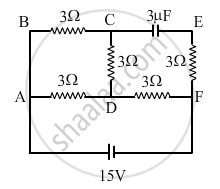
In the circuit shown in the figure, find the total resistance of the circuit and the current in the arm AD.
Choose the correct alternative.
Which of the following is an ohmic conductor?
State Ohm’s law.
Explain the equivalent resistance of a parallel resistor network.
A student carries out an experiment and plots the V-I graph of three samples of nichrome wire with resistances R1, R2 and R3 respectively. Which of the following is hue?

State Ohm’s law? How can it be verified experimentally? Does it hold good under all conditions? Comment.
Two conductors are made of the same material and have the same length. Conductor A is a solid wire of diameter 1 mm. Conductor B is a hollow tube of outer diameter 2 mm and inner diameter 1 mm. Find the ratio of resistance RA to RB.
Suppose there is a circuit consisting of only resistances and batteries and we have to double (or increase it to n-times) all voltages and all resistances. Show that currents are unaltered. Do this for circuit of Example 3.7 in the NCERT Text Book for Class XII.
