Advertisements
Advertisements
Question
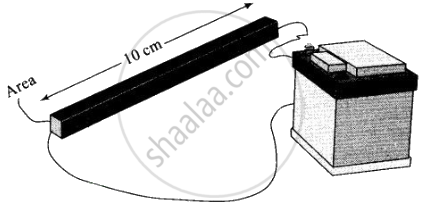
A metal rod of length 10 cm and a rectangular cross-section of 1 cm × `1/2` cm is connected to a battery across opposite faces. The resistance will be ______.
Options
maximum when the battery is connected across 1 cm × `1/2` cm faces.
maximum when the battery is connected across 10 cm × `1/2` cm faces.
maximum when the battery is connected across 10 cm × `1/2` cm faces.
same irrespective of the three faces.
Advertisements
Solution
A metal rod of length 10 cm and a rectangular cross-section of 1 cm × `1/2` cm is connected to a battery across opposite faces. The resistance will be maximum when the battery is connected across 1 cm × `1/2` cm faces.
Explanation:
The resistance of a wire depends on various parameters, its area, material (resistivity) and length (length of the rod).
Here, the metallic rod behaves as a wire.
The relationship between resistance and various parameter is given by R = ρl/A.
The resistance of a wire is given by R = `p l/A`
For greater value of R, l must be higher and A should be lower and it is possible only when the battery is connected across 1 cm × `(1/2)` cm (area of corss-section A).
APPEARS IN
RELATED QUESTIONS
If the potential difference across the ends of a conductor is 220 V and the resistance of the conductor is 44 Ω (ohm), then the current flowing through is _________.
- 0.2 A
- 0.5 A
- 2 A
- 5 A
What is Resistivity?
Name the unit of electrical resistance and give its symbol.
When a 12 V battery is connected across an unknown resistor, there is a current of 2.5 mA in the circuit. Calculate the value of the resistance of the resistor.
What is the necessary condition for a conductor to obey Ohm’s law?
A car bulb connected to a 12 volt battery draws 2 A current when glowing. What is the resistance of the filament of the bulb? Will the resistance be more same or less when the bulb is not glowing?
Calculate the electric field in a copper wire of cross-sectional area 2.0 mm2 carrying a current of 1 A.
The resistivity of copper = 1.7 × 10⁻⁸ Ω m
Rewrite the following statement by selecting the correct option.
The S.I. unit of resistance is __________.
What are non-ohmic conductors? Give one exmaple. Draw a current-voltage graph for a non-ohmic conductor.
Draw a neat diagram for the verification of Ohm’s law by voltmeter-ammeter method. By another diagram show the relation between p.d. and current.
Ohm’s law states the relationship between power and voltage.
State microscopic form of Ohm’s law.
Which of the following is correct for V-I graph of a good conductor?
Suppose there is a circuit consisting of only resistances and batteries and we have to double (or increase it to n-times) all voltages and all resistances. Show that currents are unaltered. Do this for circuit of Example 3.7 in the NCERT Text Book for Class XII.
What is meant by resistance of a conductor ? Define its SI unit.
The resistance of a resistor is reduced to half of its initial value. If other parameters of the electrical circuit remain unaltered, the amount of heat produced in the resistor will become ______.
A current of 0.8 A flows in a conductor of 40 Ω for 1 minute. The heat produced in the conductor will be ______.
Which of the following correctly defines Potential Difference (V) as one of the three core quantities of Ohm's Law?
Resistance (R) in a conductor is best described as:
