Advertisements
Advertisements
Question
A car bulb connected to a 12 volt battery draws 2 A current when glowing. What is the resistance of the filament of the bulb? Will the resistance be more same or less when the bulb is not glowing?
Advertisements
Solution
Potential Difference/Voltage (V) = 12 V
Current (I) = 2 A
Resistance (R) = ?
According to Ohm's Law:
V = IR
Then R = `"V"/"I"`
R = `12 / 2`
R = 6 Ω
Resistance will be less when the bulb is not glowing.
APPEARS IN
RELATED QUESTIONS
Fill in the following blank with suitable words:
Resistance is measured in .............. The resistance of a wire increases as the length ..............; as the temperature ..............; and as the cross-sectional area .............. .
Define Current density.
State microscopic form of Ohm’s law.
Define temperature coefficient of resistance.
A student carries out an experiment and plots the V-I graph of three samples of nichrome wire with resistances R1, R2 and R3 respectively. Which of the following is true?

State Ohm’s law? How can it be verified experimentally? Does it hold good under all conditions? Comment.
You are provided with a resistor, a key, an ammeter, a voltmeter, four cells of 1.5 V each and few connecting wires. Using circuit components, draw a labelled circuit diagram to show the setup to study Ohm's law.
State the relationship between potential difference (V) across the resistor and the current (I) flowing through it. Also draw V-I graph, taking V on the X-axis.
The circuit depicted in the figure is employed for studying Ohm’s Law. Instead of using a standard resistor, a student opts for a glass tube filled with mercury (tube 1), connected to the circuit through two electrodes, E1 and E2. He records the readings of the ammeter and voltmeter, thereby calculating the resistance. The student repeats the experiment by substituting tube 1 with tube 2, where the same amount of mercury fills tube 2.
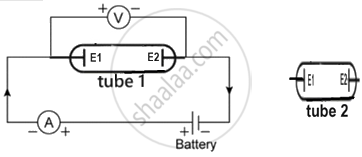
Neglecting internal resistance of the cell use (> or < or =) to compare:
- the resistance in both the cases.
- the voltmeter readings in both the cases.
- the specific resistance in both the cases.
Which of the following correctly defines Potential Difference (V) as one of the three core quantities of Ohm's Law?
If the voltage across a conductor is increased while its temperature remains unchanged, what happens to the current flowing through it?
