Advertisements
Advertisements
Question
Calculate the current flowing through a wire of resistance 5 Ω connected to a battery of potential difference 3 V.
Advertisements
Solution
Potential Difference/Voltage (V) = 3 V
Resistance (R) = 5Ω
Current (I) = ?
According to Ohm's Law:
V = IR
Then I = `"V"/"R"`
I = `3/5`
= 0.6 A
APPEARS IN
RELATED QUESTIONS
Find the resistance of a conductor if 0.24 A current is passing through it and a potential difference of 24 V is applied across it.
The graph between V and I for a conductor is a straight line passing through the origin.
What should remain constant in a statement of this law?
A car bulb connected to a 12 volt battery draws 2 A current when glowing. What is the resistance of the filament of the bulb? Will the resistance be more same or less when the bulb is not glowing?
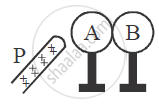
Two metallic spheres A and B kept on insulating stands are in contact with each other. A positively charged rod P is brought near the sphere A as shown in the figure. The two spheres are separated from each other, and the rod P is removed. What will be the nature of charges on spheres A and B?
The filament of a bulb takes a current 100 mA when potential difference across it is 0.2 V. When the potential difference across it becomes 1.0 V, the current becomes 400 mA. Calculate the resistance of filament in each case and account for the difference.
An ammeter placed in series with an electric radiator reads 0.5 amps and a voltmeter placed across it reads 230 volts. What is the resistance of the radiator?
Explain the equivalent resistance of a parallel resistor network.
How is electric current related to the potential difference across the terminals of a conductor?
Draw a labelled circuit diagram to verify this relationship.
Resistance (R) in a conductor is best described as:
The mathematical form of Ohm's Law is:
