Advertisements
Advertisements
Question
State macroscopic form of Ohm’s law.
Advertisements
Solution
The macroscopic form of Ohm’s law is V = IR
Where V → Potential difference
I → Current
R → Resistance.
APPEARS IN
RELATED QUESTIONS
Is Ohm’s law universally applicable for all conducting elements? If not, give examples of elements which do not obey Ohm’s law.
Name the physical quantity whose unit is "ohm".
How would you connect two resistors in series? Draw a diagram. Calculate the total equivalent resistance.
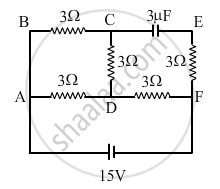
In the circuit shown in the figure, find the total resistance of the circuit and the current in the arm AD.
Tick(✓) the correct choice in the following:
Ohm's law is applicable to
State Ohm’s law.
Define temperature coefficient of resistance.
Assertion: The statement of Ohm’s law is K = IR.
Reason: V = IR is the equation which defines resistance.
State Ohm's Law. Represent it mathematically.
The electric current between two joined conductors at different potentials continues to flow until:
